How to Import Chinese EVs to Ethiopia Guide

1. Market Background & General Entry
1.1 The World's First Country to Ban Fuel Vehicles
On 29 January 2024, Ethiopia's Ministry of Transport and Logistics confirmed it would no longer allow fossil-fuel vehicles into the country, granting exemptions only to foreign electric vehicles. This makes it the first country in the world to explicitly ban fuel-vehicle imports. The backdrop is foreign-exchange pressure — Ethiopia spends roughly USD 3–5 billion per year importing petroleum, more than half of it for vehicles. The ban is a combined policy both to ease FX pressure and to bet on electrification.
1.2 Power Confidence: ~97% Renewable Energy
About 97% of Ethiopia's electricity comes from renewables (mainly hydro, supplemented by wind and geothermal). After the Grand Ethiopian Renaissance Dam comes online, generation capacity will rise further. This means electrification won't raise carbon emissions — instead, “electricity replacing oil” becomes a viable substitute.
1.3 Targets & Pace
Ethiopia's “2025–2030 Electric Mobility Strategy” targets 500,000 EVs in stock by 2030; by 2024, EVs already accounted for over 60% of new registrations. The capital, Addis Ababa, has deployed bus-level (hundreds) electric buses, and the urban transport landscape is being reshaped.
1.4 EV Tax Burden Far Below Fuel Vehicles
Fuel vehicles: 35% customs duty + 10%–100% excise by displacement + 15% VAT, with combined tax burden potentially exceeding the vehicle price itself. EVs: complete-vehicle import duty cut to 15% (some sources say it has fallen further to zero — subject to the latest ERCA announcement), CKD 5%, CBU zero; EVs enjoy exemptions across multiple excise and VAT stages. For the same vehicle, the landed cost of an EV is significantly lower than a comparable fuel vehicle.
1.5 Tariffs Are Not Calculated “China–Ethiopia” Directly, but via Djibouti Transit
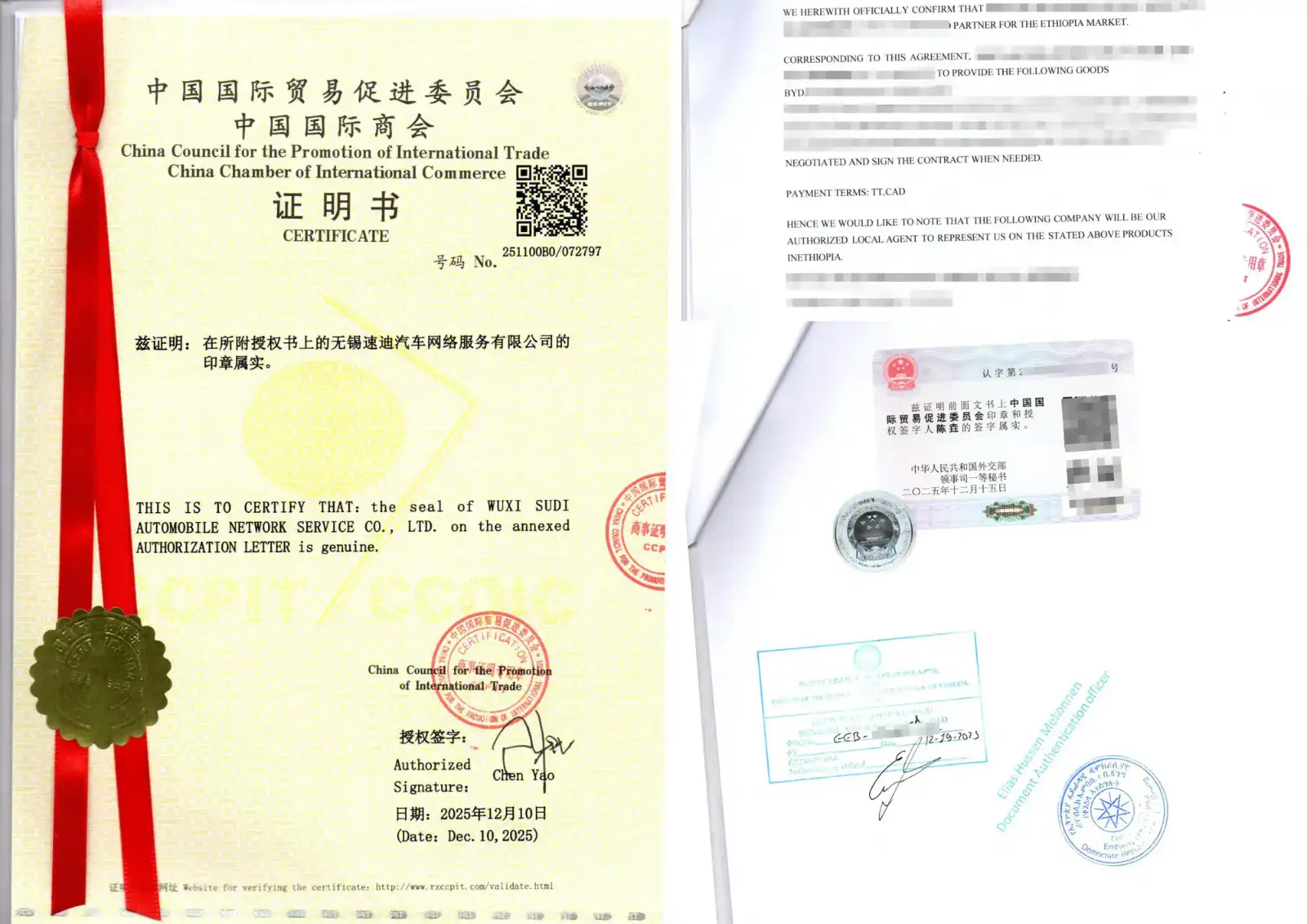
To clear up a common misconception: Ethiopian importers' tariffs are not calculated directly on a “China–Ethiopia” basis. In practice, vehicles are first exported under general trade to Djibouti, entering the Djibouti International Free Trade Zone (DIFTZ) — a bonded/free zone where no local Djibouti customs duty is involved; goods merely transit and connect. They then enter Ethiopia via road re-export in the capacity of “Djibouti origin/transit,” with import clearance and taxation completed by Ethiopian Customs. The whole chain is China → Djibouti (bonded transit) → Ethiopia — a transit structure, not a direct bilateral preferential calculation between China and Ethiopia.
Ethiopia is a Least Developed Country (LDC). China's 100%-tariff-line zero-tariff preference for diplomatic LDCs is the export-side background; but when it comes to Ethiopian Customs' taxation and origin determination, the Certificate of Origin issued by the Djibouti Chamber of Commerce is the prevailing standard (this certificate reflects the goods' identity as transiting through the Djibouti Free Zone). Therefore, when preparing, importers should organize documents around the path of “Djibouti Free Zone bonded transit + Djibouti Chamber of Commerce Certificate of Origin + Ethiopian import clearance/taxation,” rather than fixating only on the China–Ethiopia bilateral agreement.
1.6 Cognitive Time-Lag Window (references cognitive analysis)
As we analyzed in “The Truth About BYD Being Undervalued”: the policy has landed, but overseas dealers' recognition of “Chinese EVs = high quality” still lags. Ethiopia's market has just shifted from fuel to electric; early entrants can secure undervalued models and share at lower cost — the window won't stay open forever.
1.7 Left-Hand Drive Only
Ethiopia permits only left-hand-drive vehicles. Must confirm left-hand-drive configuration at procurement, otherwise the vehicle cannot be registered upon arrival.
1.8 Ethiopian Customs Clearance & Document Checklist
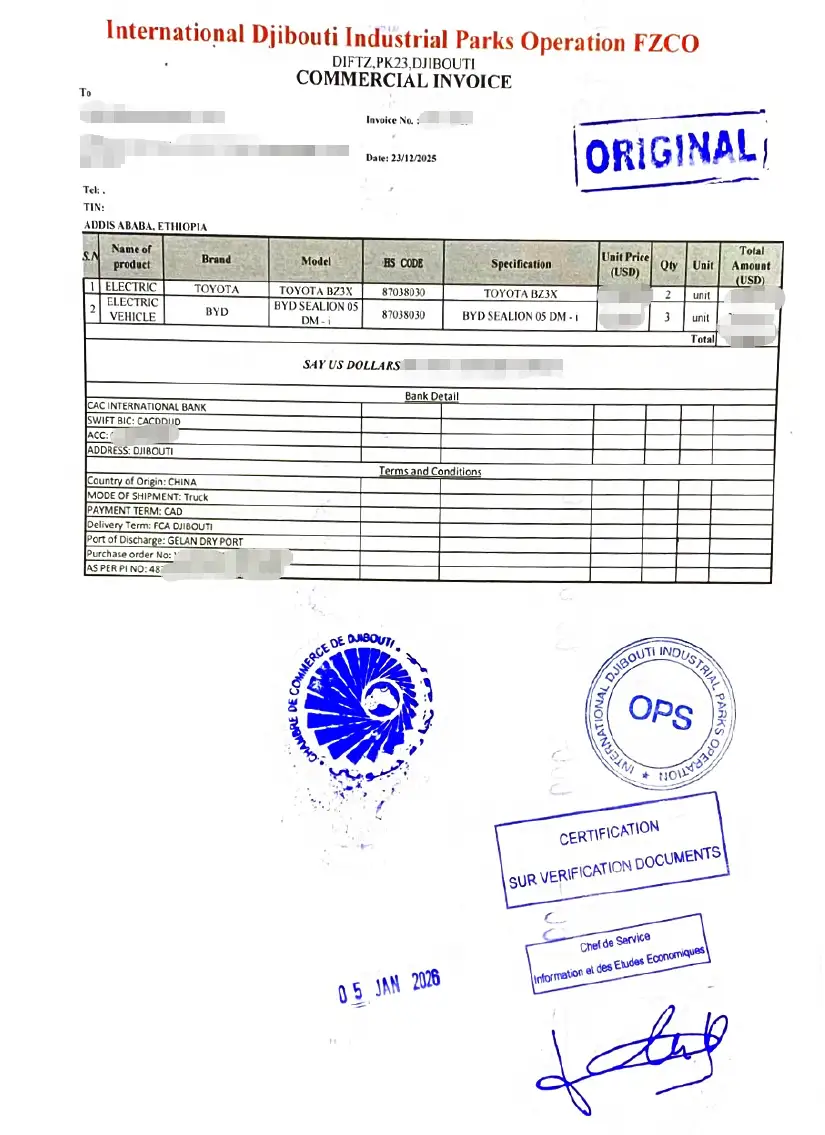
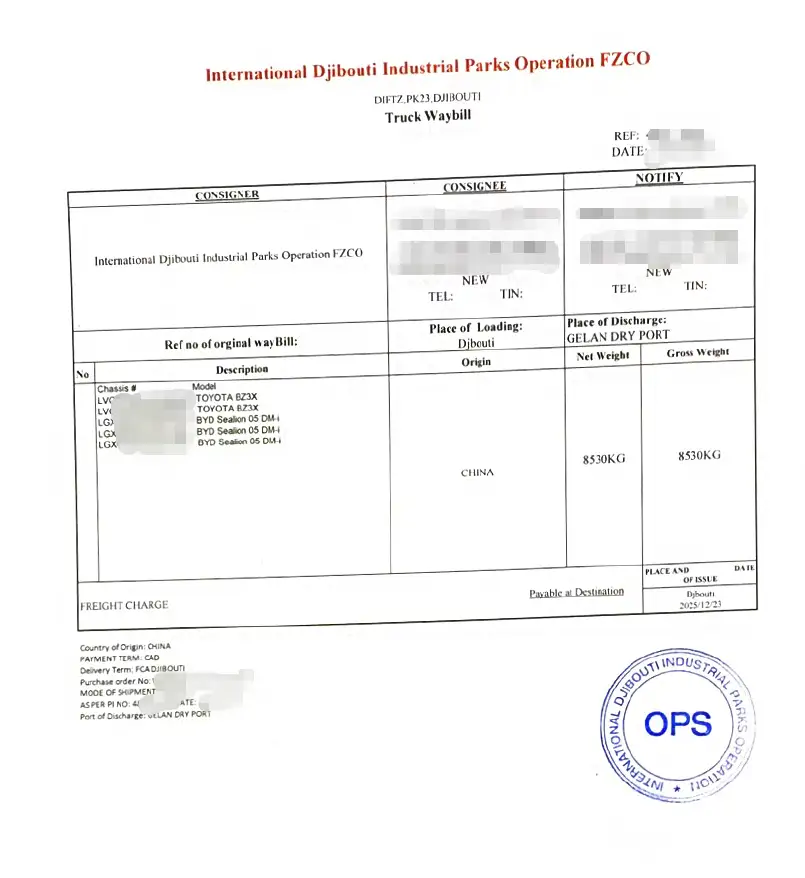
Ethiopian customs clearance is handled by the Ethiopian Revenue and Customs Authority (ERCA); an import license must first be obtained (applied by the local buyer or agent, submitted 30 days in advance). Document checklist: Certificate of Origin issued by the Djibouti Chamber of Commerce (Ethiopia generally uses this to determine origin/transit identity), commercial invoice (CIF/FOB breakdown), packing list, Bill of Lading (B/L), import license, TIN tax number, ERCA declaration (SAD 500), consular-authenticated commercial certificate from the Ethiopian embassy/consulate in China (see 1.9), and other documents.
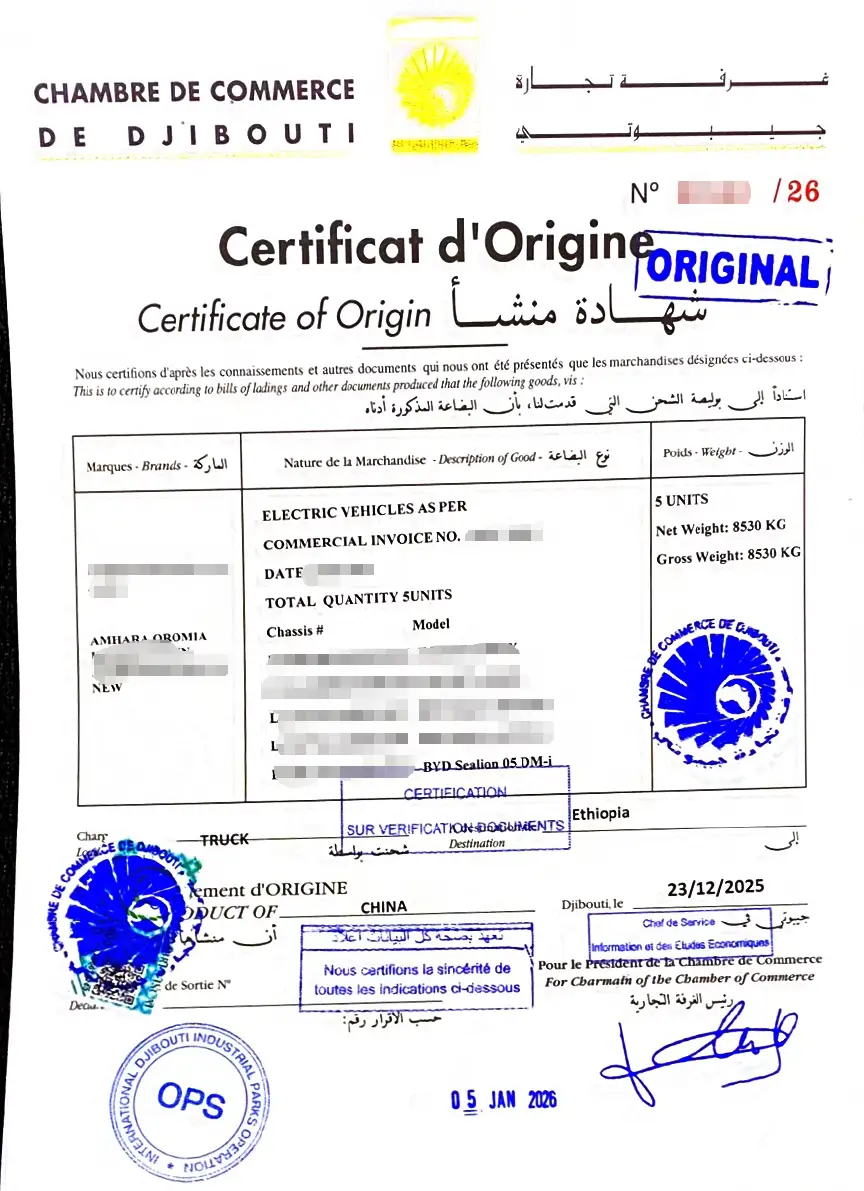
1.9 Consular Authentication: from CCPIT to the Ethiopian Embassy in China (subject to client request)
Some Ethiopian importers will require consular authentication (not mandatory for everyone — it depends on the specific requirements of the client and customs broker). The practical path: the Chinese exporter (us) first submits commercial documents to the China Council for the Promotion of International Trade (CCPIT) for a commercial certificate, then sends it to the Ethiopian embassy/consulate in China for consular authentication stamp; this authenticated certificate with the Ethiopian consular stamp is handed to the Ethiopian importer to facilitate vehicle customs declaration in Ethiopia.
This step has a long process and strict requirements on document format and seals; it is one of the compliance documents frequently requested on the Ethiopia route. SudiAuto has extensive experience with such “CCPIT + Ethiopian consulate” authentication and, if the client requires it, can manage the full process from document preparation to consular stamping.
1.10 Tax Structure (landed-price calculation)
Below, using CIF (cost + insurance + freight) as the base, we compare the tax burden differences for comparable models in Ethiopia (specific rates subject to the latest ERCA announcement):
Tax Item | Fuel Vehicle | Electric EV |
|---|---|---|
Complete-vehicle import duty | 35% | 15% (some sources say down to 0; subject to latest customs) |
Excise | 10%–100% by displacement | EV exempt |
VAT (15%) | Levied | Exempt at import and local-sales stages |
Combined tax burden | Can exceed vehicle price | Significantly lower |
2. Route One: Via Djibouti Free Zone Transit
2.1 No Seaport in Ethiopia; Djibouti Is the Only Outlet
All imported vehicles are first shipped to the Port of Djibouti, then transported by road to Addis Ababa. The Djibouti–Addis road is about 900 km; trucking typically takes 5–10 days.
2.2 Djibouti International Free Trade Zone (DIFTZ): the Bonded-Transit Fulcrum
The Djibouti International Free Trade Zone (DIFTZ) is a large free zone co-led by the Port of Djibouti Authority, China Merchants Group, etc. It is exactly the first stop of the “China → Djibouti → Ethiopia” transit chain: upon arrival, vehicles first enter the DIFTZ for bonded transit and transit connection (no local Djibouti duty involved within the zone), then enter Ethiopia via re-export. Enterprises in the zone enjoy zero tax, bonded warehousing, a currency pegged to the US dollar, and free convertibility; “Made in Djibouti” origin can also enjoy additional preferences (such as AGOA, EBA and other agreements).
SudiAuto maintains a long-term cooperation with the DIFTZ and has rich hands-on experience with vehicles transiting the zone and re-exporting to Ethiopia — from port pickup, bonded transit to road clearance, we can provide end-to-end support.
--
2.3 Djibouti ECTN: Mandatory Tracking Note Before Loading (Sea Leg)
On the “China → Djibouti” sea leg, the Port of Djibouti requires every shipment to obtain an ECTN (Electronic Cargo Tracking Note) certificate before loading; otherwise goods may be refused, fined, or even returned upon arrival in Djibouti. It must be issued by the Djibouti Ports and Free Zones Authority, submitting a draft Bill of Lading, commercial invoice, and packing list — recommended to complete 3–7 business days before loading. Important clarification: ECTN is a mandatory requirement of Djibouti (the sea destination port); goods without an ECTN will be rejected by the Djibouti port. There is an exception, however: if the sea leg is carried by Ethiopian Shipping Lines, goods can transfer directly by road into Ethiopia upon arrival in Djibouti without stopping, and no Djibouti ECTN is needed — see 3.1 (Route Two).
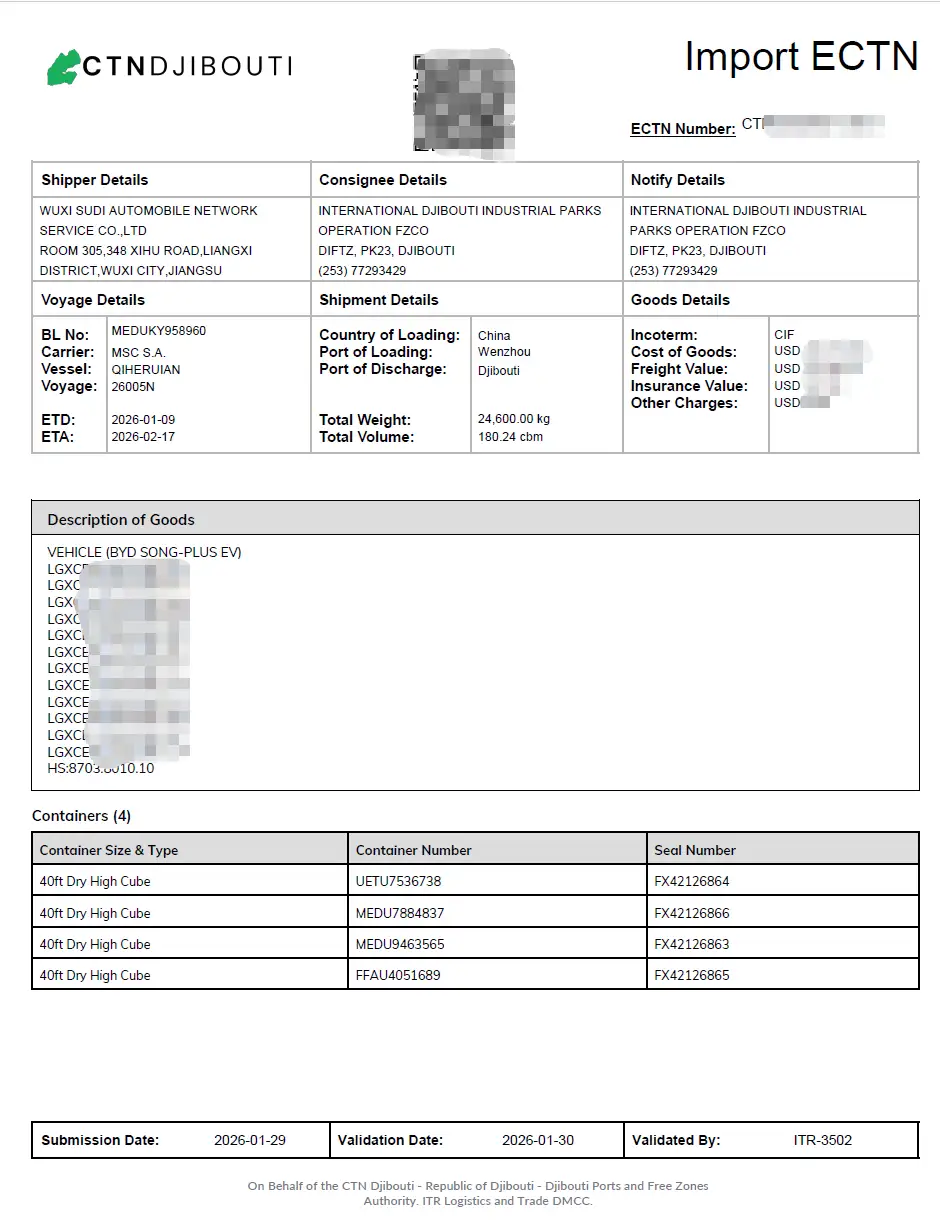
2.4 Bonded-Zone Transit: Buying Time for Importers with Tight Cash Flow
Importers choosing DIFTZ bonded transit: upon arrival in Djibouti, goods first enter the free zone's bonded warehousing without immediate customs clearance, and can stay in-zone and raise funds in batches before re-export to Ethiopia. For importers with tight cash flow who need to finance in stages, this bonded stay equates to buying a time window for cash-flow scheduling — and this is the core flexibility of this route versus the Ethiopian Shipping Lines direct route. The ECTN, however, still must be processed per Djibouti sea-leg requirements (see 2.3).
3. Route Two: Ethiopian Shipping Lines Sea-Land Intermodal
3.1 ESL Direct-Transfer Route: Exempt from Djibouti ECTN
When the transport is carried by Ethiopian Shipping Lines (ESL), goods can enter Ethiopia directly by road upon arrival in Djibouti without stopping — no Djibouti ECTN required. This is currently the fastest route to reach Ethiopia.
3.2 Practical Recommendation: FOB Terms, Importer Books Directly
Practical recommendation: adopt FOB trade terms, with the Ethiopian importer booking directly with Ethiopian Shipping Lines. ESL arranges the intermodal transport as the shipper of the shipment, so goods only transit-connect in Djibouti without local clearance stop, thereby bypassing the Djibouti port's mandatory ECTN requirement for “inbound/transit” cargo.
3.3 Cash-Flow Threshold: Cannot Stop Once Started
Note: this route has a cash-flow threshold for the importer — ocean freight, Ethiopian clearance fees, etc. must be paid promptly throughout, the process cannot stop once started, and clearance documents must be prepared in sync. Importers with ample funds who can book independently are better suited to this route.
4. Comparison of the Two Routes
Below, from six dimensions — carrier, transit time, ECTN, cash-flow threshold, recommended trade terms, and suitable importers — we compare the two routes:
Dimension | ESL Direct Transfer (Mode A) | DIFTZ Transit (Mode B) |
|---|---|---|
Carrier | Carried by ESL; importer books directly with ESL | Carried by non-Ethiopian shipping co.; transits via DIFTZ |
Transit time | Fastest — enters Ethiopia directly by road upon arrival in Djibouti without stopping | Slower — goods stay/transit in Djibouti bonded zone before entering Ethiopia |
ECTN | Exempt (no local Djibouti clearance stop) | Required (mandatory Djibouti sea-leg tracking note) |
Cash-flow threshold | High — ocean freight, Ethiopian clearance fees must be paid promptly throughout; process cannot stop; documents must be ready in sync | Low — bonded-zone stay buys scheduling time for importers with tight cash flow |
Recommended trade terms | FOB recommended; importer manages sea leg | CIF/CFR possible; exporter arranges to Djibouti |
Suitable importers | Well-funded, time-sensitive, can book independently | Tight cash flow, need staged financing |
5. Recommended Models (BYD / Linghui only, left-hand-drive EV)
All models below are built on mature platforms, fitting Ethiopia's demand structure centered on electric buses, commercial use, and left-hand drive. Confirm configuration and certification against your target customer segment before importing:
Special note: BYD Sealion 06 is the successor model to the former Song Plus, with outstanding product strength and supply stability — listed as this guide's strongly recommended model.
Brand / Model | Type | Ethiopia Fit Scenario |
|---|---|---|
BYD Seagull | Compact pure-electric hatchback | Family / city commute / ride-hailing |
BYD Dolphin | Pure-electric hatchback | Family / city commute / ride-hailing |
BYD Sealion 06 (Strongly Recommended · successor to Song Plus) | Pure-electric SUV | Family / commercial / replaces Song Plus |
Linghui e5 | Pure-electric sedan (Qin PLUS EV platform) | Ride-hailing / taxi |
Linghui e7 | Pure-electric mid-size sedan | Commercial / family |
Linghui e9 | Pure-electric C-segment sedan | Business |
Linghui M9 | Plug-in hybrid MPV | Reception / large family |
6. Supplier Screening & SudiAuto's Role
6.1 Three Certificates, One Check
Verify business license/export qualification, manufacturer authorization or dealership rights, and past export records; also require live video vehicle inspection (cold start, chassis, mileage). For importers validating local uptake and turnover with a “trial order,” we recommend running a small batch first before scaling up.
6.2 What SudiAuto Can Provide
SudiAuto focuses on BYD's Chinese complete-vehicle export and can handle large-volume wholesale (single-container trial → full-shipment level). Relying on our long-term cooperation with the DIFTZ, we provide for the Ethiopia route: model selection (left-hand-drive EV), Chinese export declaration and CCPIT–Ethiopian consular authentication, Djibouti port pickup and bonded transit (then re-export to Ethiopia), ECTN (mandatory Djibouti sea-leg tracking note) processing, and one-stop support from Djibouti to Ethiopia.
Further reading: “Linghui Brand Introduction.”
7. Conclusion
With one policy, Ethiopia shut fuel vehicles out — and opened an entire market to Chinese EVs. For importers, the key is not “can the car get in,” but “whose cognition and channels arrive first.” SudiAuto is willing to build long-term cooperation with scaled import wholesalers, and leveraging the fulcrum of the Djibouti Free Zone, grow the Ethiopia-route business together.
8. Frequently Asked Questions (FAQ)
Q1: Does Ethiopia import only left-hand-drive vehicles?
A: Yes. Ethiopia permits only left-hand-drive vehicle imports; left-hand-drive configuration must be confirmed at procurement, otherwise the vehicle cannot be registered.
Q2: What is ECTN and why must it be obtained before loading?
A: ECTN (Electronic Cargo Tracking Note) is a mandatory requirement of the Port of Djibouti for “China → Djibouti” sea-leg cargo; a certificate must be obtained before each shipment loads. Missing it may cause goods to be refused, fined, or returned upon arrival in Djibouti; issued by the Djibouti Ports and Free Zones Authority, requiring a draft B/L, invoice, and packing list. Clarification: ECTN is a Djibouti (sea destination port) requirement, not an Ethiopian Customs requirement — goods entering Ethiopia do not repeat ECTN. Exception: if the sea leg is carried by Ethiopian Shipping Lines, goods do not stop locally in Djibouti and ECTN is exempt (see 3.1, Route Two).
Q3: What can SudiAuto do for Ethiopian importers?
A: We focus on BYD Chinese complete-vehicle export, have obtained Linghui dealership rights, and can handle large-volume wholesale; together with our long-term DIFTZ cooperation, we provide one-stop support from model selection, Chinese export declaration (including CCPIT–Ethiopian consular authentication), Djibouti pickup bonded transit, ECTN (mandatory Djibouti sea-leg tracking note) to road clearance.
Q4: Do all Ethiopian importers need consular authentication?
A: Not mandatory for everyone. Consular authentication is a document some Ethiopian importers (especially first-time clearance, or when a cooperating broker requires it) will request — the Chinese exporter obtains a commercial certificate via CCPIT, then sends it to the Ethiopian embassy/consulate in China for consular stamp; with this authenticated certificate bearing the Ethiopian consular stamp, it facilitates vehicle customs declaration in Ethiopia. If the client requires it, we recommend planning the processing cycle in advance.
FAQ
Q.Why should I buy from you not from other suppliers?
We are not the cheapest. But we are the kind of company that will still be here even 10 years after you sell the car. — Our chairman, Mr. Ye, has been in the automotive industry since 1985 (when China still had planned automobile distribution), making him one of China's first auto traders, with over 40 years of experience. All our inventory photos are real shots, not copied from the internet — a reflection of our group's commitment to honest trading.
Q.Who are you?
We are WUXI SUDI AUTOMOBILE NETWORK SERVICE CO., LTD., based in Wuxi City, Jiangsu Province, China, starting from 2024, as a vehicle export team of the Meidi Auto Group. In 2025, we exported over 1,000 vehicles with a trade volume of USD 23 million, serving customers across four continents. In 2026, we established vehicle warehouses in Cambodia, entering the cross-border operations development stage.
Q.How can you guarantee quality?
Always Inspection before shipment. We can conduct vehicle inspections by a third party based on the customer's requirements and issue a reliable report. Our partners include institutions such as APT and Dr. Cha.
Q.Do you have the products in stock?
Yes, our current inventory cars are displayed on the website. You can browse at any time. Large quantities must be produced according to orders, and small quantities can be consulted with our sales team.
Q.What can I buy from you?
All vehicle models of BYD brand, covering Dynasty, Ocean, Linghui, Commercial and many other series. We are the largest BYD dealer in Wuxi City, occupying 90% of Wuxi City market. We cooperate directly with BYD factory in China.
Q.Can I mix different models in one container?
Yes, different models can be mixed in one container.
Q.What's your warranty term?
We offer different warranty periods for different products. Please contact us for detailed warranty terms.
Q.Will you deliver the right goods as ordered? How can I trust you?
Yes, we will. The core of our company culture is honesty and credit. We are a verified supplier by V-trust since 2024.
Q.What is your payment?
Payment Currency: USD, HKD, CNY. Payment Type: T/T.
Q.What is your shipping terms?
Delivery Terms: EXW, FCA, FOB, CFR, CIF.
Q.What services can you provide?
Customer visit or car inspection full reception service, product samples or accessory services, etc.