Analysis: Why BYD's used-car are undervalued??
1. A Puzzle That Confuses Overseas Vehicle Dealers
1.1 The Cambodian Dealer’s Real Calculus: Resale Capacity Sets the Price
In an emerging market like Cambodia, when a dealer takes in a vehicle the first question is not “is this a good car” but “will someone take it off my hands at resale.” Local awareness of BYD is still at an early stage; end-demand is uncertain and the used-car cycle is immature. So the dealer’s offer logic is straightforward: the more a model is feared to sit in inventory, the lower its acquisition and retail price is pushed.
1.2 The Awkward Case of the BYD E3: Its Used Price Sits Below the Toyota Prius
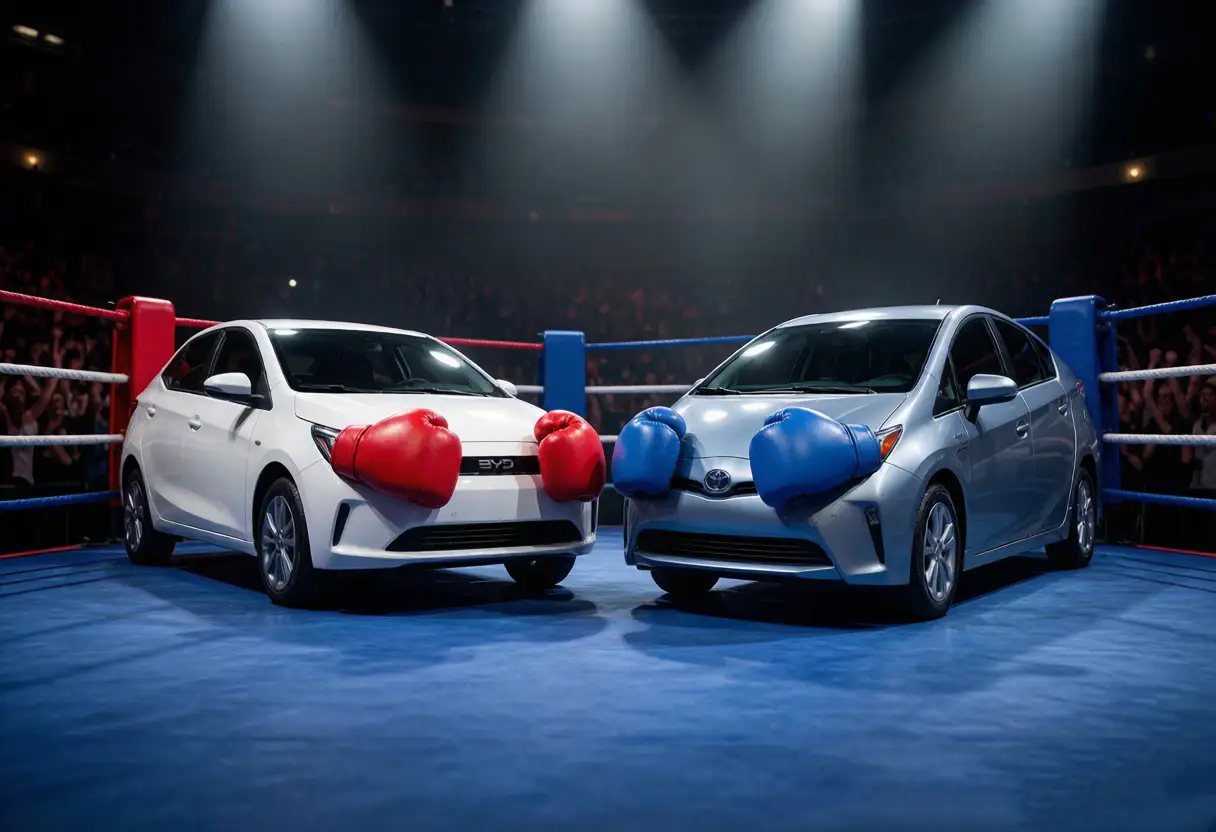
A typical example is the BYD E3. In Cambodia its used transaction price is sometimes even lower than that of a comparable Toyota Prius - a model already regarded as the “everyman’s value king” of the fuel and hybrid era. This inversion does not come from product strength; it comes from liquidity expectations: dealers worry the E3 will not move and will turn over slowly, so they hedge risk with an extremely low residual value.
1.3 Beneath the Surface: It Is Not a Bad Car, It Is the Fear That “No One Will Take It”
Treating the price inversion as evidence that “BYD does not stack up” is a reversal of cause and effect. What really suppresses the price is the market’s confidence in resale, not the vehicle’s intrinsic quality. Once perception corrects and demand picks up, today’s low price becomes tomorrow’s margin.
2. Turning Back to China: Toyota Is Now “Building EVs With BYD”
2.1 An Overlooked Fact: Toyota’s Three-Electric Systems Come From BYD
Shift the lens back to China and you see a fact overseas markets routinely miss: the Toyota bZ3, a Toyota produced pure-electric model, adopts BYD’s blade battery and e-drive system directly. In other words, this global benchmark of the fuel era chose deep cooperation with an external partner for the core components of its EV product.
2.2 The Three-Electric Systems Are the Core of an EV - and BYD Holds the Full Stack
The center of value in an EV shifted long ago from the engine and gearbox to the “three-electric” systems - battery, motor, and electronic control. BYD is among the few Global automakers with full-stack in-house R&D and mass-production capability across the three-electrics: from cell chemistry and blade-battery structure to motor and electronic control, its vertical integration places it among the more deeply integrated players in the industry. Mastering the three-electrics is equivalent to mastering the EV’s “engine, gearbox, and fuel tank combined.”
2.3 From “Follower” to “Followed”: The Roles Have Reversed
When a legacy giant depends on an external supplier for its core components, the balance of industry voice has already tilted. Overseas markets are still stuck in the fuel-era impression that “Toyota equals reliability,” but the shift in technology tracks moves far faster than the refresh of brand impressions.
3. The Perception Gap in Overseas Markets
3.1 Information Asymmetry in Late-Starter Markets
Late-starter markets like Cambodia often receive lagged or even distorted information: Toyota’s gold-lettered reputation is carried over wholesale, while BYD’s true technical level is rarely sorted out systematically. The information gap is the price gap.
3.2 “Toyota Equals Reliability” Is a Relic of the Fuel Era
The judgment “Toyota is reliable” was built on decades of fuel-car word-of-mouth - a historical asset. But in the EV era the definition of reliability has changed: it is no longer about whose engine lasts, but whose three-electric system is more mature and whose warranty is more stable. The old ruler cannot measure the new value.
Dimension | Fuel-Era Ruler (Old) | EV-Era Ruler (New) |
|---|---|---|
Reliability | Long brand history = reliable | Mature three-electricity technology= reliable |
Resale logic | Large parc = holds value | Tech leadership + accelerating penetration = re-rating |
Technical core | In-house engine / gearbox | In-house battery / motor / electronic control |
Resale expectation | Mature used market | Rapid resale after perception corrects |
3.3 This Gap Is Precisely the Importer’s Window
The perception gap will not last forever. It means: those who build position before most peers catch on can secure undervalued models and share at a lower cost.
To turn this judgment into execution, we have also prepared country-by-country import playbooks - the Peru and Chile versions are live, and a Cambodia market guide is in preparation. For importers, the two ends of capturing the window are: first understand the perception gap, then use the guide to complete a compliant landing.
4. The Value Collapse of the Priuses: A Trailer From the Chinese Market
4.1 What Happened in China: The Unraveling of the Hybrid Value Myth
The Chinese market has already run this script once. As NEV penetration climbed quickly, the used-car residual rates of some fuel car models that built their name on “fuel savings and value retention” showed a clear decline - buyers became far more willing to pay for new platforms, long range, and smart features, and used demand for the old paradigm was rapidly diluted.
Turn the lens on China’s used-car market and the contrast is stark: a BYD E3 with roughly 120,000 km on the odometer still fetches around 40,000 RMB domestically, while the Toyota Prius, once hailed as the hybrid benchmark, now finds almost no buyer in China’s used-car market, Directly enter the scrap plant for dismantling as scrap iron, and become the main destination for the Prius. Within the same market, on one side is the liquidity resilience of BYD models, on the other the liquidity collapse of an old-paradigm benchmark - Cambodia’s present “E3 below Prius” is merely a temporary mirror image under the perception gap, and the reversal China has already lived through is the ending far more worth referencing.
4.2 The Tipping-Point Logic: Once Penetration Crosses the Threshold, Resale Value Collapses Instantly
This is not a slow slide; it is more like a threshold: before EV penetration crosses a certain band, the old models can coast on inertia to hold price; once crossed, the demand structure shifts gears and residual value gives way in a short window. China’s NEV passenger-car penetration had already stabilized above 45% in 2024 and broke 50% in multiple individual months - precisely the band that triggers the shift.
4.3 This Is Not an Isolated Case; It Is the Shared Fate of This Class of Car
The Prius is not a lone case; it is the common predicament of the entire “fuel and weak-hybrid paradigm” category. Any model whose value is anchored to the old technology paradigm faces a similar re-rating of its residual value once the EV shift completes.
5. The Conclusion for Overseas Importers: Build Position Before the Consensus Corrects
5.1 The Low-Price Window Is Closing
The low price of models like the E3 in Cambodia today is essentially a perception discount. As information spreads and demand awakens, this discount will be filled quickly. The window is finite.
5.2 The Sourcing Logic: Buy “Undervalued Technology,” Not “A Familiar Badge”
For importers, the real opportunity is not chasing familiar brands but identifying technology assets mispriced by the market. Shift the procurement judgment from the “badge” to “three-electric strength and full-lifecycle cost,” and you capture the dividend of this re-rating.
5.3 What SudiAuto Can Support
SudiAuto focuses on the export of complete vehicles from two brands - BYD and Geely Radar - from China. We can advise on a model’s three-electric configuration, the compliance and resale path for the target market, and provide one-stop support from procurement, FTA certificate of origin, to ocean freight and customs clearance - helping importers build a sound position within the window.
If you have decided to act, refer to our country-by-country playbooks: How to Import Chinese EVs to Peru and How to Import Chinese EVs to Chile (a Cambodia guide is in preparation). From “understanding the undervaluation” to “completing the import,” we provide continuous support.
6. FAQ
Q1: Is Toyota Really Using BYD’s Three-Electric Systems?
A: Take the Toyota bZ3 as an example - its battery and e-drive system adopt BYD’s solution. This reflects the external dependence of legacy automakers on core EV components, and is a concrete entry point for observing the migration of industry voice.
Q2: Is It Still Time to Import BYD?
A: The window remains open but is narrowing. We suggest starting with a trial order (around 3 units to fill one container) to validate local resale and turnover, then scaling up gradually.
7. Conclusion
The low overseas price is a limited-time discount handed out by the perception gap. When the fact that “even Toyota uses BYD’s three-electrics” is understood by more people, today’s undervalued models will eventually be re-priced. For importers, the question was never “is BYD good enough” but “did you get on board before others understood.”
FAQ
Q.Why should I buy from you not from other suppliers?
We are not the cheapest. But we are the kind of company that will still be here even 10 years after you sell the car. — Our chairman, Mr. Ye, has been in the automotive industry since 1985 (when China still had planned automobile distribution), making him one of China's first auto traders, with over 40 years of experience. All our inventory photos are real shots, not copied from the internet — a reflection of our group's commitment to honest trading.
Q.Who are you?
We are WUXI SUDI AUTOMOBILE NETWORK SERVICE CO., LTD., based in Wuxi City, Jiangsu Province, China, starting from 2024, as a vehicle export team of the Meidi Auto Group. In 2025, we exported over 1,000 vehicles with a trade volume of USD 23 million, serving customers across four continents. In 2026, we established vehicle warehouses in Cambodia, entering the cross-border operations development stage.
Q.How can you guarantee quality?
Always Inspection before shipment. We can conduct vehicle inspections by a third party based on the customer's requirements and issue a reliable report. Our partners include institutions such as APT and Dr. Cha.
Q.Do you have the products in stock?
Yes, our current inventory cars are displayed on the website. You can browse at any time. Large quantities must be produced according to orders, and small quantities can be consulted with our sales team.
Q.What can I buy from you?
All vehicle models of BYD brand, covering Dynasty, Ocean, Linghui, Commercial and many other series. We are the largest BYD dealer in Wuxi City, occupying 90% of Wuxi City market. We cooperate directly with BYD factory in China.
Q.Can I mix different models in one container?
Yes, different models can be mixed in one container.
Q.What's your warranty term?
We offer different warranty periods for different products. Please contact us for detailed warranty terms.
Q.Will you deliver the right goods as ordered? How can I trust you?
Yes, we will. The core of our company culture is honesty and credit. We are a verified supplier by V-trust since 2024.
Q.What is your payment?
Payment Currency: USD, HKD, CNY. Payment Type: T/T.
Q.What is your shipping terms?
Delivery Terms: EXW, FCA, FOB, CFR, CIF.
Q.What services can you provide?
Customer visit or car inspection full reception service, product samples or accessory services, etc.