Is China Ending the Vehicle Export Tax Rebate?
1. Where Things Actually Stand
1.1 So far it is only a proposal
Let us be precise about this. As of publication, the export tax rebate rate for complete passenger vehicles across all HS 8703 subheadings is still 13%, identical to the VAT rate. Nothing has changed.
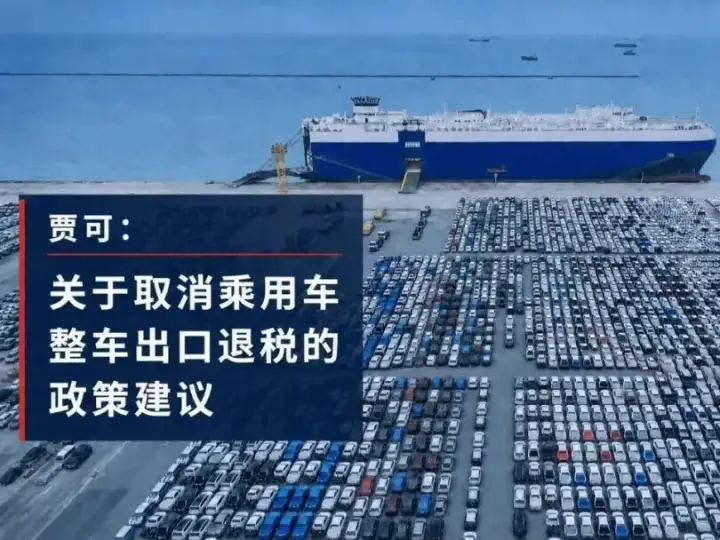
Jia Ke’s article draws on his own visits over the past two years to more than ten countries across Southeast Asia, the Middle East, Central Asia, Europe, North Africa, North America and South America. It is a policy proposal published in a trade journal for discussion. It does not represent the position of the Ministry of Finance or the State Taxation Administration, and no official timetable comes with it.
The next few sections explain why it is still worth your time.
1.2 The soft official guidance has already moved first
On 24 August 2026, the Ministry of Commerce, the Ministry of Industry and Information Technology and the State Administration for Market Regulation jointly issued the Guidelines on Overseas Competition Conduct and Compliance Building for the Automotive Industry, released publicly on 1 September.
The document asks companies to price on the basis of cost and international supply and demand, to avoid frequent and sharp price swings when recommending retail prices abroad, and not to disrupt market order in pursuit of unfair competitive advantage.
Its status, however, is “for reference”. No penalties are attached, and it is not tied to export eligibility or rebate eligibility. It can send a signal. It cannot change anyone’s cost structure.
To actually move the numbers on a company’s books, something else is needed. The export rebate rate is one of those levers.
1.3 Solar and batteries have already been down this road
Export rebate rates have never been fixed. They move as an industry matures. Solar and batteries are the two most recent examples:
• In 2024, the rebate rate on solar products and batteries was cut from 13% to 9%.
• From April 2026, the VAT export rebate on solar products was abolished. The battery rate dropped to 6% and is scheduled for abolition in 2027.
Solar went from 13% to zero in under two years.
The auto industry arguably qualifies even more. In 2025 China exported 2.615 million new energy vehicles, up 103.7% year on year. In the first half of 2026, complete vehicle exports reached USD 91.8 billion, up 54%, with June alone at USD 18.2 billion, a 70% increase. The figures come from the General Administration of Customs, compiled by Cui Dongshu, secretary-general of the China Passenger Car Association. An industry growing at that rate does not need a rebate to push it along.
2. The Signal Has Appeared: Why We Think 2027 Is the Window
The last chapter was about what has already happened. This one is about timing.
Our view: China’s vehicle export tax rebate will change materially in 2027 and disappear entirely within one to two years. The days of treating that rebate as a discount are running out.
2.1 A three-step rhythm
In China, fiscal and tax policies with wide impact are rarely issued overnight. They usually follow three steps.
• Signal period. The authorities float views through industry associations, research institutes or trade media, and watch how companies and markets react. Articles at this stage are carefully worded, and their titles tend to carry words like “proposal”, “reflection” or “discussion”.
• Announcement period. The Ministry of Finance and the State Taxation Administration issue a formal circular setting out the scope, the new rate and the effective date.
• Effective period. The policy takes effect. Transition windows are usually short.
The moment for making decisions sits in the first box. By the second box, the window has essentially closed.
2.2 The solar precedent: from call to take-effect, 16 days
Solar is the most recent and most complete case study. Laid out on a timeline, the three steps are unmistakable.
In the signal period, the China Photovoltaic Industry Association stated its position publicly. It noted that some companies, competing on price, had converted the export rebate into bargaining room with foreign buyers, so that public funds meant to offset domestic VAT were being surrendered to overseas purchasers at the negotiating table. In substance, it argued, the rebate had become a subsidy to overseas end markets. On that basis, the association considered that lowering or cancelling the solar export rebate at the right moment would help bring foreign market prices back to rational levels and reduce the risk of trade friction.
Then came two announcements, both startlingly fast:
• On 15 November 2024, the Ministry of Finance and the State Taxation Administration issued Announcement No. 15 of 2024, cutting the export rebate rate on solar products, batteries and other goods from 13% to 9%, effective 1 December 2024. Publication to take-effect: 16 days.
• On 8 January 2026, they issued Announcement No. 2 of 2026, abolishing the VAT export rebate on solar products from 1 April 2026, and cutting the battery rate from 9% to 6% for the period from 1 April to 31 December 2026, with abolition from 1 January 2027. Publication to take-effect: 83 days.
Both announcements contain the same sentence: the rebate rate applicable to the listed products is determined by the export date stated on the customs declaration form.
Put simply, the rate you get depends on the export date on the declaration. Neither the contract date nor the payment date counts.
2.3 One detail: the two sets of wording are strikingly similar
Read the China Photovoltaic Industry Association’s statement alongside Jia Ke’s 3 September article and something stands out.
The association said companies convert the export rebate into bargaining room with foreign buyers, public funds are surrendered to overseas purchasers during negotiation, and the rebate in substance becomes a subsidy to overseas end markets.
Jia Ke wrote that some overseas buyers already treat China’s export rebate as an “implicit discount” the exporter is certain to receive, and that this price benefit has been transferred to overseas channels through procurement negotiation before the goods even leave the country.
Both describe the same thing: the benefit of the rebate is flowing outward. The logic, the causation and even the order of the argument line up.
That does not look like coincidence. It looks like a judgement already formed at the policy research level and released industry by industry. In solar’s case, the rebate hit zero seventeen months after the signal went out.
2.4 External pressure: 19 to 1 at the G20 table
There is one more timeline, and it explains why the signal is going out now.
From 31 August to 1 September 2026, the second G20 Finance Ministers and Central Bank Governors Meeting was held in Asheville, North Carolina. China objected to four paragraphs of the statement, no joint communiqué was issued, and the United States as rotating chair published a chair’s summary on its own.
US Treasury Secretary Scott Bessent said after the meeting that 19 members agreed the continued dumping of cheap exports by non-market economies is unsustainable, with China the sole dissenter. The chair’s summary called on countries with excessive and persistent external surpluses to expand domestic consumption, remove the imbalances that make growth overly dependent on exports, and take steps to roll back the non-market policies and practices that worsen those imbalances.
On 2 and 3 September, PBOC Governor Pan Gongsheng, Vice Finance Minister Liao Min, Foreign Ministry spokesman Guo Jiakun and Commerce Ministry spokeswoman Huang Ling responded in turn, reiterating that China has never deliberately pursued a trade surplus and rejecting “overcapacity” as a pretext for protectionism.
Jia Ke’s article proposing the cancellation of the passenger vehicle export rebate was published on 3 September.
Put the dates together and the picture is clear. External pressure to roll back non-market policies and practices peaked in early September, and a response capable of being implemented was needed. Among the options available, adjusting the export rebate is the most direct and the easiest for outsiders to verify.
2.5 Our judgement: 2027 is the window
• The first step, from 13% to 9%, most likely lands in the first half of 2027. Solar took several months to a year from signal to first adjustment, and this signal went out in September 2026.
• Full abolition is expected around 2028, one to two years from now.
• On the transition window, solar gave 16 days and 83 days. Expect somewhere between half a month and three months from announcement to take-effect.
One caveat. This is an inference from public information, not an official commitment and not a timetable. The authorities may well choose a different pace, or leave things exactly as they are.
For an importer, the value of that inference is not whether it turns out to be accurate. It is that the inference points to where the window is. If your purchasing decision only starts after the announcement, then regardless of whether this call is right, you are already late.
3. Who Actually Receives the 13%
3.1 What the rebate was designed to do
The internationally accepted principle behind export rebates is to zero-rate indirect taxes on exported goods. Refund the VAT paid domestically, let goods enter international markets tax-free, avoid double taxation.
One distinction matters here. Viewed as a tax mechanism, this is a tax-neutral arrangement and does not automatically constitute an export subsidy in WTO terms. The European and American countervailing actions against Chinese electric vehicles have focused on cheap credit, land, raw materials and other input support. The export rebate is not at the centre of those investigations.
In Chinese practice, though, the rebate rate has always carried an industrial policy function as well. When the system was set up in 1985, expanding exports and earning foreign exchange were explicit goals. After WTO accession it gradually shifted to structural adjustment: lower or zero rebates for energy-intensive, polluting and resource-based products, higher rates for machinery, electronics and high value-added goods. Vehicles have long been in the second group.
3.2 The money is split three ways
Who ends up with the price benefit depends on bargaining power along the chain. In today’s Chinese vehicle export business, there are roughly three outcomes.
• It becomes the exporter’s profit or market spend. When demand outstrips supply, the product is differentiated and the exporter holds pricing power, the room the rebate creates turns into margin, or gets spent on channel building, aftersales networks and brand promotion.
• It is bargained away layer by layer. With domestic capacity abundant, several Chinese brands crowding the same market and many export entities competing, that room is easily conceded at the table. Some overseas buyers have already written “what the Chinese company gets back in rebate” into their landed cost model as an implicit discount.
• It is eaten by the cost of capital. Vehicle purchases, warehousing, logistics, insurance and channel costs all have to be paid up front, while the rebate only arrives after customs clearance, document review and tax filing. The longer the wait, the more the company has to finance itself, and the more interest it carries.
3.3 Why some exporters say they would rather not have it
The result is a mismatch. The overseas customer has already deducted the rebate in the negotiated price, while the exporter is still waiting for the money and carrying the financing cost.
When exporters on the ground say they would rather not have the rebate, they are not asking to pay more tax. They want pricing to return to a clean post-tax basis so buyers stop using the rebate policy as a lever against them.
There is something important in that sentence for importers. If your current purchase price already rests on your supplier passing the rebate through to you, then when the rebate goes, your increase will be larger than you expect, because that benefit was never really yours.
4. The Numbers: How Much Will Export Prices Rise
4.1 Correcting a common mistake first
The most widely repeated line is that a 13% rebate means a 13% price increase when it goes. That is wrong.
The rebate refunds input VAT the exporter paid on domestic purchases. It is not a 13% top-up on export sales value.
• A pure trading exporter buys complete vehicles and re-exports them. Its input tax base is close to the full vehicle purchase cost, so the hit is close to 13%, or more precisely 13% of the tax-exclusive purchase cost.
• A vertically integrated manufacturer develops its own battery, motor and electronic controls and builds its own packs. Only part of the vehicle value is purchased externally, and the value the company creates itself generates no input VAT, so there is nothing to rebate on it. The lower the external share, the smaller the hit.
The impact therefore differs enormously between suppliers. And that difference determines who you should be buying from.
4.2 Impact by exporter type
Take a simplified model. Let α be the exporter’s tax-inclusive external purchase cost as a share of the FOB price. If the rebate rate goes from 13% to 0%, with the export stage still tax-exempt, the cost shock relative to the FOB price is approximately 11.5% × α.
The 11.5% is 13% ÷ 1.13. Converting the tax-inclusive purchase cost to a tax-exclusive base gives the share of input VAT in the FOB price.
| Exporter type | α: external tax-incl. cost / FOB | Theoretical FOB increase | Note |
|---|---|---|---|
| Pure trading exporter, buys complete vehicles and resells | approx. 95%–100% | 10.9%–11.5% | Input tax base close to full purchase price; largest impact |
| Assembly-type or low-integration exporter | approx. 70% | approx. 8.1% | Core components mostly purchased |
| Vertically integrated OEM with own battery, motor and e-controls | approx. 50% | approx. 5.8% | Self-created value generates no input VAT; smallest impact |
Three things to keep in mind when using this table.
• These are theoretical ceilings. Actual quotes also depend on order size, competition, exchange rates and profit targets, and exporters usually absorb part of the shock themselves.
• If the cut is phased, say 13% to 9% to 5% to 0, each step’s impact scales down proportionally. The step from 13% to 9% is roughly 30% of a full abolition.
• Actual rebate amounts depend on the specific HS code, taxable value, input structure and the exemption-credit-refund mechanism. Use the table to gauge order of magnitude and set a negotiating anchor, not for final settlement.
4.3 What it means on your books: the landed cost
The rebate hits the FOB price at the Chinese port. Ocean freight, insurance, destination tariffs, customs clearance, inland transport, certification and registration are all unaffected by China’s rebate, so the FOB increase is diluted by its share of total landed cost.
Base case: a Chinese-brand battery electric SUV at USD 20,000 FOB Chinese port, shipped to a Latin American market with a 6% tariff.
| Cost item | Current, USD | Full pass-through, USD | Split 50/50, USD |
|---|---|---|---|
| FOB Chinese port | 20,000 | 22,300 | 21,150 |
| Ocean freight and insurance | 1,800 | 1,800 | 1,800 |
| Destination tariff at 6% | 1,308 | 1,446 | 1,377 |
| Customs clearance, port charges, inland transport | 800 | 800 | 800 |
| Certification, registration, compliance | 300 | 300 | 300 |
| Total landed cost | 24,208 | 26,646 | 25,427 |
| Landed cost increase | — | +10.1% | +5.0% |
One more thing worth noting. The higher the destination tariff, the smaller FOB’s share of landed cost, but tariffs are calculated on CIF, so a higher FOB also raises the tariff. The two roughly cancel out. Across tariff rates from 6% to 45%, our calculations put the landed cost increase consistently at around 10%.
A rough rule of thumb is enough: landed cost increase is approximately the FOB increase × 0.85 to 0.9.
4.4 Three market types, three outcomes
The size of the increase is one question. Whether it can be passed through to the showroom is another.
• Red-ocean markets with fierce competition, where several Chinese brands fight head to head and buyers are highly price-sensitive: exporters will likely absorb a substantial part themselves. Real landed cost increases may land at 4%–6%. Smaller exporters with weak absorption capacity may simply exit.
• Markets with brand premium or policy support, where local new energy subsidies exist, consumers accept Chinese technology and competitors sit clearly higher on price: pass-through is smooth, increases of 8%–10% with no visible damage to volume.
• High-tariff, high-barrier markets such as the European Union, where a 10% base tariff plus countervailing duties of up to 35.3% combine to a maximum of 45.3%: the absolute amount of the rebate loss is magnified by the tariff, but the relative increase stays around 10%. The real variable in these markets is the price undertaking mechanism, not the export rebate.
5. The Overlooked Upside: This Is Actually Good News for Importers
If you only see the price increase, you miss the part of this change that is worth something to you.
5.1 Less price war, less inventory write-down risk
One of the hardest problems in Chinese vehicle export markets is price chaos between channels for the same brand and model. You buy a batch at one price, two months later the same car is 8% cheaper at the next port, and your stock has already lost value.
The room the rebate created for price cuts is part of what funds that chaos. Take the room away and there is less ammunition for indiscriminate discounting. For an importer trying to build a market properly, a stable price system matters far more than saving a few thousand dollars once.
5.2 The shakeout removes the least stable link
A rebate change widens the gap between players. Businesses surviving on low-margin resale, rebate cash flow and short-term arbitrage will see margins compress. Suppliers who have built brand, channel and aftersales systems will put more weight on long-term presence in overseas markets.
For you, the result is that the Chinese suppliers you meet at trade shows will be fewer and more reliable. The ones quoting absurdly low prices, disappearing after delivery and running aftersales off a single messaging account will go first.
5.3 One political label comes off
With trade issues increasingly politicised, an export rebate is easy for outside actors to repackage as evidence that the Chinese government subsidises low-priced exports, a ready-made label for protectionist campaigns.
Cutting and eventually removing the rebate will not make Europe or America drop their trade barriers. It does remove an easy target, and it gives China more room to manoeuvre in negotiations over price undertakings, tariff arrangements and local investment. For you that means a more predictable policy environment, and less risk of waking up one morning to a fresh round of duties on Chinese cars.
6. What Importers Should Do Now: Seven Moves
6.1 Move 1: do not stake the window on an announcement
The instinct for many importers is to wait for the announcement and then rush orders in before the effective date. In vehicle exports that logic fails, and the reason is in the numbers from section 2.2.
Solar’s first adjustment was published on 15 November 2024 and took effect on 1 December, a 16-day window. The second was published on 8 January 2026 and took effect on 1 April, 83 days. Meanwhile ro-ro and container space from China to Latin America, the Middle East and West Africa usually has to be locked in four to eight weeks ahead in peak season, on top of time for consolidation, inspection and customs clearance.
On the day of the announcement, the window has essentially closed. Space is gone, and there is no time to clear customs. Worse, the rebate follows the export date on the declaration, not the contract date or the payment date, so a signed contract that has not been declared is still priced at the new rate.
Solar offers one more lesson. After the announcement the industry saw a clear rush to export: according to People’s Daily, analysts at the research firm SMM expected battery module exports to roughly double in the first quarter of 2026, while TrendForce warned that the rush would put pressure on ocean logistics and overseas delivery capacity.
For you that means the moment the announcement lands, your Chinese suppliers are buried in rush orders, space tightens instantly and lead times slip across the board. Either you put your orders into the production plan during the signal period, or you queue up behind the rush, pay the new rate and still do not get priority delivery.
So this step is not about waiting for policy. Treat the first half of 2027 as a real purchasing deadline and start talking to suppliers now about production slots, space and price locks. Three months of extra carrying cost is far cheaper than being forced to accept a supplier’s new price once the policy lands.
6.2 Move 2: switch your price basis from rebate-inclusive to net of rebate
This is the most valuable step and the easiest to overlook.
The Chinese quote in front of you right now probably already has the rebate concession baked in. When the rebate goes, your supplier will raise prices citing the policy change. But how much of a rise is reasonable? If you do not know how much rebate was in the original price, you have no choice but to accept whatever they say.
The right move is to ask suppliers to break the quote open: base price excluding rebate, plus the rebate credit, equals the current quote. Or more directly, ask for the net price assuming a zero rebate rate.
With that structure you can work backwards using the formula in section 4.2. If they are a pure trading house, a reasonable ceiling is around 11.5%. If they are a vertically integrated OEM, around 5.8%. Anything well beyond that is a price rise wearing policy clothing.
6.3 Move 3: put a tax-change clause in your contracts
From now on, every contract you sign should carry one. Five elements:
• Anchor the baseline. State that this quotation is based on the export rebate rate of 13% applicable on a given date, and name the main HS codes.
• Fix the test. Agree that the applicable rate is the one matching the export date stated on the customs declaration, so there is no argument about the moment that counts.
• Write the formula. Say something like, for each percentage point the rebate rate is cut, the FOB price rises by the corresponding proportion of the agreed tax base. Avoid a vague “if policy changes, the parties shall negotiate separately”.
• Share the burden. Agree that the portion above a threshold, say 5%, is split between both sides in a stated ratio, so neither party carries all the policy risk.
• Cover orders in transit. Specify how orders with deposits paid, orders scheduled for production and orders with space booked but not yet declared are handled.
The clause can be short, but baseline, test, formula, sharing and in-transit are all mandatory. Drop any one of them and a dispute turns into an argument.
This is not theory. After the battery export rebate was cut in early 2026, China’s lithium battery industry widely adopted a similar mechanism: building tax changes into quotation mechanisms and contract terms, stating clearly how the burden is shared, and using indexed, clause-based approaches with long-term contract customers to avoid one-off shocks.
Put bluntly, your Chinese supplier is probably already signing clauses like this with other customers. The only question is whether your contract has one.
6.4 Move 4: book early, but do not hoard
Ordering ahead of a rate change makes sense, but run two numbers first.
The first is the cost of capital. Buying three to six months of stock early means carrying costs, storage and insurance that can eat a large part of the price difference you captured.
The second is the risk of a price fall. If price competition among Chinese exporters actually eases after the change, or a better-value new model appears in your market, the stock you are holding becomes a liability.
The practical approach: keep pre-buy volume within three to four months of real sales, and prioritise fast-turning, steady-demand volume models. For high-unit-price, slow-turning models, do not stock up just to catch a tax rate.
6.5 Move 5: rebuild your TCO and your retail pricing
With landed cost up 5% to 10%, should retail prices follow? Look at your market structure first.
If Chinese brands are fighting each other at close quarters locally, following the price up may cost you share outright. The more realistic option then is to compress your own margin and use instalments, leasing or lease-to-own structures to lower the customer’s sensitivity to the monthly payment.
If the market is less price-elastic for Chinese brands, with competitors clearly higher up the price ladder and new energy penetration still climbing fast, a 5% to 8% increase usually will not move volume much.
Either way, redo a full total cost of ownership calculation and put acquisition cost, energy, maintenance, insurance and residual value together in the customer’s decision frame. The running-cost advantage of a Chinese electric vehicle often offsets several thousand dollars of extra acquisition cost once you look at TCO, and that is your strongest argument with a customer facing a price rise.
6.6 Move 6: evaluate switching from CBU to KD or SKD
One myth to clear up first: going KD does not get you around China’s rebate change.
Vehicle parts under the relevant HS Chapter 87 subheadings mostly carry the same 13% rebate rate. If the complete vehicle rebate is cancelled, parts are very likely in the same round. Note also that traction batteries exported as standalone goods dropped to 6% from April 2026 and are scheduled for abolition in 2027, so any KD kit declaring the battery separately already sits on a lower rate.
The real value of KD lies elsewhere: avoiding high destination tariffs on complete vehicles, and qualifying for local assembly incentives.
In many markets, duty on knocked-down kits is significantly lower than on complete vehicles. If your market charges above 20% on built-up cars and under 10% on CKD kits, KD may still be the better route even with the Chinese rebate fully gone.
KD has entry barriers though. Minimum order quantities, commonly in the range of 100 units a year or more, local assembly space and tooling, a local certification cycle, and a team that can survive the ramp-up. It is a 12 to 24 month play, not a short-term answer to this round of rebate changes.
6.7 Move 7: add supplier vertical integration to your selection criteria
Back to the calculation in section 4.2. Once the rebate goes, a highly integrated OEM takes a cost hit of around 5.8% while a pure trading house takes around 11.5%, roughly double.
Over the next two to three years, buying from more integrated suppliers will leave you carrying noticeably less of the policy pass-through. The reason is simple: a smaller share of their cost base is exposed to the rebate, and the cost advantage from developing their own battery, motor and e-controls is structural, not dependent on any tax policy.
Put vertical integration on your supplier scorecard alongside price, lead time and aftersales terms. During a period of policy change, that metric deserves more weight.
7. Frequently Asked Questions
7.1 What makes you think 2027 is the window?
Three pieces of public evidence point the same way.
• First, solar provides a complete precedent. The China Photovoltaic Industry Association said publicly that the rebate benefit was being surrendered to overseas purchasers during negotiation, and that lowering or cancelling the solar export rebate at the right moment would help prices return to rational levels. The Ministry of Finance and the State Taxation Administration then issued circulars in November 2024 and January 2026, first cutting to 9% and then abolishing it outright. The signal, announcement, take-effect path has been walked end to end.
• Second, autos are reproducing the same sequence of signals. The three ministries issued their Guidelines on 24 August 2026, and Jia Ke published his proposal to cancel the rebate on 3 September, less than two weeks later.
• Third, external pressure peaked in the same period. The G20 finance ministers and central bank governors meeting of 31 August to 1 September 2026 failed to issue a joint communiqué after China objected to four paragraphs, with 19 members calling for the rollback of non-market policies and practices that worsen global imbalances.
Extrapolating from solar’s rhythm, the first adjustment follows the signal by several months to a year, and full abolition follows the first adjustment by about seventeen months. That puts the first adjustment most likely in the first half of 2027 and full abolition around 2028.
To repeat: this is an inference, not an official timetable. But purchasing plans have to rest on some assumption, and this is the most reliable one the public record supports today.
7.2 Has the rebate cancellation been confirmed?
No. As of publication the export rebate rate for complete passenger vehicles is still 13%, and no official document has announced a change or set a timetable. The 3 September 2026 article proposing cancellation is a researcher’s recommendation, not policy.
That said, taken together with the solar and battery phase-outs and the August 2026 Guidelines from the three ministries, policy discussion in this direction has entered the mainstream. It is worth planning for.
7.3 Will Chinese exporters use this as cover to overcharge?
Some will, and you can defend against it. The key is to make suppliers break out their quotes and state the rebate credit, then judge the increase against the anchor of external tax-inclusive cost × 13%.
In categories where competition is intense and suppliers care about the long-term market, the room to overcharge is limited anyway. Few will risk a customer buying several hundred units a year for three extra points of margin.
7.4 Does this affect buy-order export, bonded zone or comprehensive bonded zone pickup?
Yes, but differently. Under the current system these structures derive part of their value from flexibility in customs clearance and cash flow, and part from the timing advantage in rebate filing. Once the rebate goes, the part tied directly to the rebate disappears, while the flexibility in clearance efficiency and funding arrangements remains.
If your business relies heavily on these structures, recalculate their total cost under a zero-rebate scenario and compare item by item against ordinary trade exports.
7.5 Will losing the rebate cost Chinese cars their price competitiveness abroad?
There is a short-term shock and limited medium-term impact. Chinese vehicles compete abroad mainly on technology, supply chain efficiency and manufacturing cost, which are structural advantages that sit outside the rebate.
In the first half of 2026, the value of China’s complete vehicle exports rose 54% year on year, and new energy passenger vehicle exports rose 78.7%. A 13% rebate is plainly not what is driving that. The more likely outcome is the elimination of exporters dependent on low prices and short-term arbitrage, and a return to a more rational price structure, rather than Chinese cars losing competitiveness across the board.
7.6 Do my existing contracts need special handling?
Yes. From now on, new contracts should include a tax-change clause, as set out in section 6.3.
For contracts already signed but not yet executed, if the contract has a price adjustment clause, follow it. If it is a fixed-price contract and the supplier asks for more citing the policy change, push for a shared solution: you take half the increase in exchange for delivery guarantees, longer payment terms or extra aftersales support. Turn an imposed cost increase into a chance to renegotiate the whole package.
8. Closing: Turn the Policy Window Into a Chance to Re-Pick Your Suppliers
The export rebate did real work during the four decades in which Chinese manufacturing came up. But the value of a policy instrument is precisely that it can be withdrawn once the industry has grown up. Solar’s went, steel’s went, batteries are going. Whether autos are next will probably become clear in the next 12 to 24 months.
Our view has not changed. China’s vehicle export tax rebate will change materially in 2027 and be gone within one to two years. The days when importers could enjoy that rebate as a discount are running out.
The response is not complicated. Work out your real cost structure, switch your price basis to net of rebate, write the rules into your contracts, and use this window to go through your supplier list again.
What you should actually worry about is not paying 5% or 10% more. It is reaching the announcement day and finding that you cannot get space, you do not know who to order from, and a competitor put their orders into the production plan six months ago.
SudiAuto (速迪汽车) specialises in Chinese new energy vehicle exports, with more than 1,000 vehicles shipped and USD 23 million in export value across more than 10 countries, focused on BYD and Geely Radar models. Our quotations break out the cost structure and the rebate treatment explicitly, and we are happy to contract on tax-change terms. Policy changes; the numbers should still be out in the open.
9. Sources
The core material for this article comes from the following report: Jia Ke, “Policy Proposal on Cancelling the Export Tax Rebate for Complete Passenger Vehicles”, published in Auto Business Review on 3 September 2026 and carried by Tencent News: https://view.inews.qq.com/k/20260903A04AO400
Other references:
• Ministry of Finance and State Taxation Administration Announcement No. 15 of 2024, issued 15 November 2024, effective 1 December 2024.
• Ministry of Finance and State Taxation Administration Announcement No. 2 of 2026, issued 8 January 2026, effective 1 April 2026.
• Guidelines on Overseas Competition Conduct and Compliance Building for the Automotive Industry, issued 24 August 2026 by the Ministry of Commerce, the Ministry of Industry and Information Technology and the State Administration for Market Regulation, released 1 September 2026.
• General Administration of Customs import and export statistics for automotive products, first half of 2026, compiled by Cui Dongshu, secretary-general of the China Passenger Car Association.
• People’s Daily, “Solar Export Rebate Adjusted Again, Forcing Faster Industry Upgrade”, 19 January 2026.
• Second G20 Finance Ministers and Central Bank Governors Meeting, 31 August to 1 September 2026, Asheville, United States, and the post-meeting statements from China and the United States.
FAQ
Q.Why should I buy from you not from other suppliers?
We are not the cheapest. But we are the kind of company that will still be here even 10 years after you sell the car. — Our chairman, Mr. Ye, has been in the automotive industry since 1985 (when China still had planned automobile distribution), making him one of China's first auto traders, with over 40 years of experience. All our inventory photos are real shots, not copied from the internet — a reflection of our group's commitment to honest trading.
Q.Who are you?
We are WUXI SUDI AUTOMOBILE NETWORK SERVICE CO., LTD., based in Wuxi City, Jiangsu Province, China, starting from 2024, as a vehicle export team of the Meidi Auto Group. In 2025, we exported over 1,000 vehicles with a trade volume of USD 23 million, serving customers across four continents. In 2026, we established vehicle warehouses in Cambodia, entering the cross-border operations development stage.
Q.How can you guarantee quality?
Always Inspection before shipment. We can conduct vehicle inspections by a third party based on the customer's requirements and issue a reliable report. Our partners include institutions such as APT and Dr. Cha.
Q.Do you have the products in stock?
Yes, our current inventory cars are displayed on the website. You can browse at any time. Large quantities must be produced according to orders, and small quantities can be consulted with our sales team.
Q.What can I buy from you?
All vehicle models of BYD brand, covering Dynasty, Ocean, Linghui, Commercial and many other series. We are the largest BYD dealer in Wuxi City, occupying 90% of Wuxi City market. We cooperate directly with BYD factory in China.
Q.Can I mix different models in one container?
Yes, different models can be mixed in one container.
Q.What's your warranty term?
We offer different warranty periods for different products. Please contact us for detailed warranty terms.
Q.Will you deliver the right goods as ordered? How can I trust you?
Yes, we will. The core of our company culture is honesty and credit. We are a verified supplier by V-trust since 2024.
Q.What is your payment?
Payment Currency: USD, HKD, CNY. Payment Type: T/T.
Q.What is your shipping terms?
Delivery Terms: EXW, FCA, FOB, CFR, CIF.
Q.What services can you provide?
Customer visit or car inspection full reception service, product samples or accessory services, etc.