China NEV Export Tax Rebate to 9% 2027
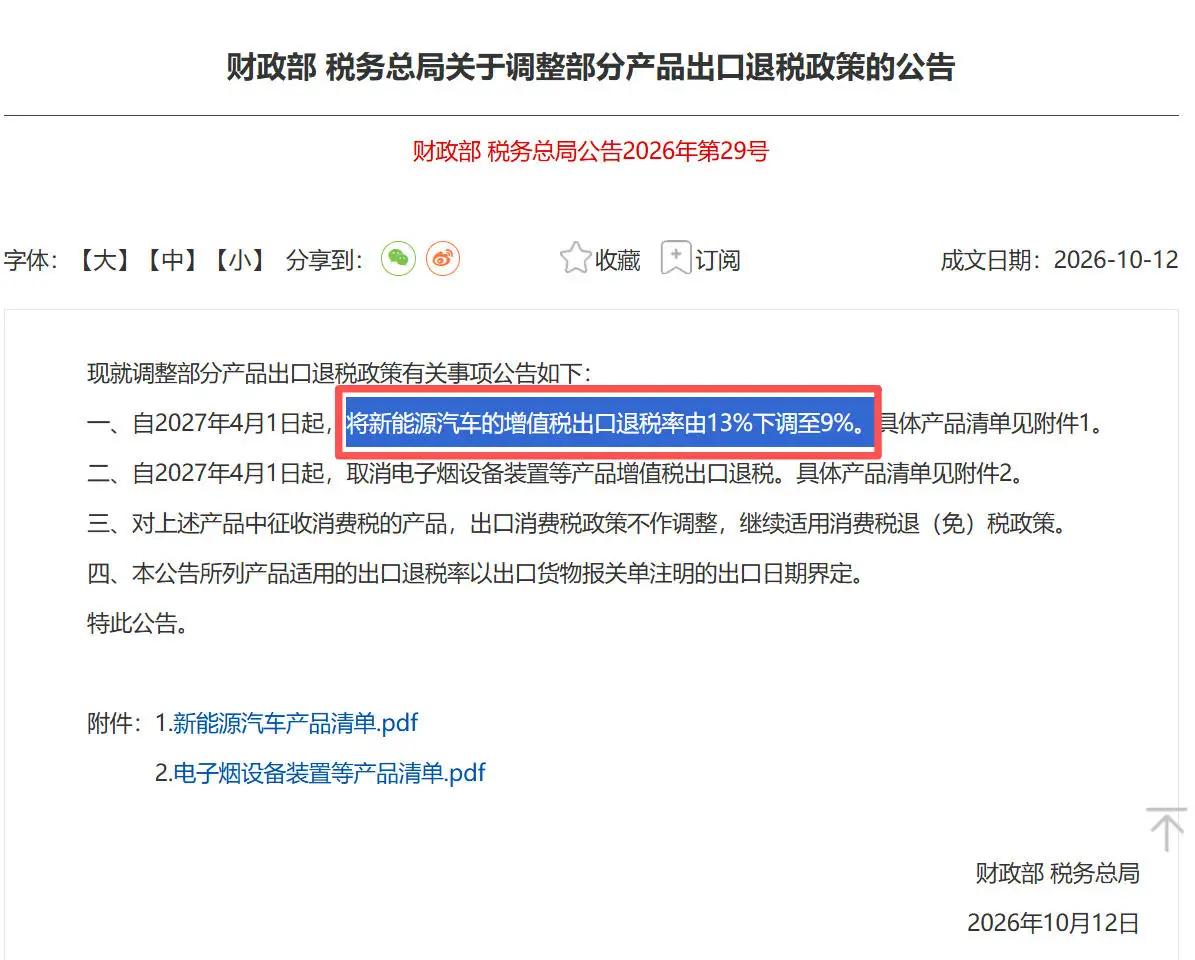
If you import vehicles overseas, this announcement is directly relevant to you. On 12 October 2026, the Ministry of Finance and the State Taxation Administration issued Announcement No. 29: the export tax rebate rate for new energy vehicles drops from 13% to 9%, effective 1 April 2027.
Five months remain. Over those five months, Chinese suppliers and overseas importers compete for the same vessel slots in the same stretch of time. Whoever runs the numbers first and gets production and customs declarations scheduled first pays less for the same thing. This article is written for importers and covers three things only: how to read the rules, how to do the arithmetic, and how to sequence the next few months.
1. The Announcement Is In: Four Rules and How Importers Should Read Them
1.1 The Provisions That Bear Directly on Importers’ Purchase Cost
The document is Ministry of Finance and State Taxation Administration Announcement No. 29 of 2026, dated and published on 12 October 2026 (link at the end of this article). The provisions that bear directly on importers’ purchase cost are as follows:
One. From 1 April 2027, the VAT export tax rebate rate for new energy vehicles is cut from 13% to 9%. The detailed product list is in Annex 1.
Two. From 1 April 2027, the VAT export tax rebate is cancelled for products such as electronic cigarette devices and equipment. The detailed product list is in Annex 2.
Four. The export tax rebate rate applicable to the products listed in this Announcement is determined by the export date stated on the export goods customs declaration.
Article one gives the number, article two gives the scope, article four gives the basis for determination. For importers, article four is the dangerous one, and it gets its own section below.
1.2 Scope: 67 Tariff Lines Covering BEVs and PHEVs
According to China EV Pulse (link at the end of this article), this cut covers 67 product tariff lines, including battery-electric passenger cars, plug-in hybrid passenger cars (including range-extended models) and electric commercial vehicles (electric buses, tractors and the like).
This one is for confirming which orders are affected. The new energy models you buy from us — electric SUVs, electric sedans, electric pickups, plug-in hybrids and range-extended vehicles — all fall inside this adjustment, and the quote structure for each of them has to be renegotiated against the new rebate rate.
1.3 The Basis for Determination: The Export Date on the Customs Declaration
Article four is worded almost identically to the 2024 solar announcement and the 2026 battery announcement: the rebate rate follows the export date stated on the export goods customs declaration.
• The signing date does not count. The payment date does not count. The booking date does not count. Only the export date printed on the customs declaration counts.
• Vehicles declared for export on or before 31 March 2027 are taxed at 13%. Vehicles declared on or after 1 April are taxed at 9%.
• Vehicles already scheduled for production, already paid for, already booked onto a vessel but not yet declared for export fall under the new rate, whatever the contract says.
That last one is where disputes come from, and it is the single clause most worth writing into your purchase contract in black and white. A supplier will tell you the contract was signed in March with the price locked at 13%. If the actual declaration slips into April, the tax difference still lands on you.
2. Compared With Our September Forecast: What We Got Right and What Did Not Change
2.1 What We Got Right
In September 2026 we published a forward-looking analysis of the export tax rebate policy (in-house article, link at the end of this article). We made three calls at the time: the first step would most likely fall in the first half of 2027, full cancellation would be expected around 2028, and the transition period would be benchmarked against the 16-day and 83-day solar precedents.
Set against today’s announcement:
• The first step, 13% down to 9%, lands on 1 April 2027 — in the first half of 2027. The call was right.
• 141 days from publication to effect, which is more generous than either of the two precedents we referenced (16 days, 83 days).
• The step-down is 4 percentage points — exactly what we forecast for the first step.
2.2 What Did Not Change: This Is Not a Cancellation
The title of our September piece used the word “cancelled” to make the policy signal unambiguous. Now that the official announcement is out, the wording needs calibrating.
The accurate formulation is: the VAT export tax rebate rate for new energy vehicles is cut from 13% to 9%, a reduction of 4 percentage points. It is electronic cigarette devices and equipment and similar products whose export tax rebate is cancelled.
How big is the difference? A full cancellation would have hit FOB prices on the order of 11.5%. Going from 13% to 9% is on the order of 3.5%. If your supplier reaches for the cancellation framing in the old article to scare a price increase out of you, keep your head: that was the old framing, not this announcement.
2.3 This Window Is Far More Generous Than the Solar Ones
Put the three transition periods side by side. Solar, first round: issued 15 November 2024, effective 1 December, 16 days. Second round: issued 8 January 2026, effective 1 April, 83 days. This time, for vehicles: issued 12 October 2026, effective 1 April 2027, 141 days.
141 days from the issue date. RoRo peak-season vessel slots normally have to be locked 4 to 8 weeks ahead, and you still need slack for cargo consolidation at the port, customs inspection and the declaration itself. The announcement has already landed, and the window is still open.
This is completely different from 2024. Back then, when the announcement came out, the slots were essentially gone and companies were left to comply passively. This time you have time to do two things: get the price structure nailed down, and get the production schedule and the vessel slots in.
3. The Account Importers Should Run: How Big Are 4 Percentage Points
3.1 A Static Reading: 8,000 Yuan Less Per Vehicle
China Business Journal’s calculation uses a static model (link at the end of this article): for a new energy vehicle with a 200,000 yuan FOB price, the rebate at 13% is 26,000 yuan and at 9% it is 18,000 yuan, so the rebate income falls by 8,000 yuan. For a company exporting 100,000 vehicles a year, rebate income drops by 800 million yuan in the ideal case.
8,000 yuan looks large, and it lands directly on your purchase price. The FOB quote you receive is already a net price that assumes the 13% rebate. When the rebate rate drops from 13% to 9%, the portion deducted in advance shrinks, which is the same thing as an extra cost on top of the old price. Who ends up carrying that cost — the supplier absorbing it out of margin, or passing it on to you — depends on your bargaining position. That gets its own section below.
3.2 Three Institutions, Three Methods, One of Which Applies to You
Deutsche Bank’s calculation: the step-down cuts BYD’s net profit by roughly 5,000 yuan per exported vehicle, about USD 743, taking effect from the second quarter of 2027. J.P. Morgan ran a sensitivity test on the assumption that automakers pass on none of it: BYD and another new energy start-up could see 2027 earnings fall by around 18%, Geely by around 10%, Great Wall and Chery by 6% to 8%.
Changjiang Securities comes closest to the end market: the overseas retail price of the BYD ATTO3 runs at about 1.3 to 2.6 times its domestic price, with a midpoint of about 2 times. A 4-percentage-point cut applies to a tax base equal to the FOB price, which sits below the overseas retail price, so the expected impact on gross margin is less than 2 percentage points.
The three numbers do not contradict each other. They measure three different things: net profit per vehicle (Deutsche Bank), profit elasticity under a no-price-increase assumption (J.P. Morgan), and gross margin in percentage points (Changjiang Securities). For a pure trading exporter, the first two are what matter — we have no OEM margin pool to absorb 4 percentage points, so the tax difference lands on the FOB quote almost by definition. Changjiang’s sub-2-percentage-point figure describes a vertically integrated OEM. For a trading quote like the one you will receive, the number to watch is the roughly 3.5% FOB impact set out above. The earlier you lock at the old 13% rate inside the window, the more you keep.
3.3 Landed Cost: The Number You Actually Track
The calculation framework from our previous article still holds. Let α be the share of tax-inclusive purchased cost in the exporter’s FOB quote; a full cancellation hits FOB by roughly 11.5%×α (11.5% = 13% ÷ 1.13, converting tax-inclusive purchase cost into a tax-exclusive base).
This time the rebate drops 4 percentage points rather than going to zero, so the impact scales down proportionally:
• Pure trading exporters (buy complete vehicles and re-export, α close to 1): FOB impact of roughly 3.5%.
• Vertically integrated OEMs (in-house three-electric systems, self-made batteries and e-drives, roughly half of the bill purchased): FOB impact of roughly 1.8%–2%.
Landed cost converts using the rule of thumb (multiply the FOB increase by 0.85 to 0.9, deducting the freight share):
• Pure trading: landed cost rises by roughly 3.0%–3.2%.
• Vertically integrated OEM: roughly 1.5%–1.8%.
This reconciles with Changjiang Securities’ conclusion that gross margin takes less than a 2-percentage-point hit. Two independent paths land on the same order of magnitude, and this is a number you can take into a supplier negotiation with confidence.
3.4 Which Suppliers Are Most Exposed
Overseas revenue share in 2025: Chery 52.4%, Great Wall 41.1%, BYD 38.7%, SAIC 23.2%, Geely 21.4%. But overseas revenue share is not exposure. The share of new energy vehicles in the export mix is what matters — the higher that share and the more the company competes on price and volume, the stronger its incentive to pass the tax difference on to you.
To judge whether a supplier will come asking for a price increase, look at three indicators: how high the new energy share of its exports is, how weak its bargaining power is, and whether it competes on low price and high volume. The heavier the share and the more price-led the model, the more likely the tax difference lands in the quote. Moody’s Ratings offers a confirming view: manufacturers that have already built a domestic business and run a diversified export footprint face limited disruption.
The other side of the coin is more encouraging. Tian Zhiwei of Shanghai University of Finance and Economics is more optimistic: new energy vehicles have become a competitive track in China’s trade exports, and cutting the rebate rate will not put significant pressure on overall export volumes. The implication for importers is direct: supply will not dry up. What you need to worry about is your position in the price negotiation, not where the vehicles come from.
4. The Rush Window: Work Backwards From the Customs Declaration Date
4.1 A Four-Month Timeline
Run the timeline backwards and it becomes your list of actions, month by month:
• November to December 2026: settle the quote structure with your supplier. Ask for the base price and the rebate line separated, or a net price at the 9% rate. Do this now and the initiative is yours.
• January 2027: lock vessel slots and sign production schedules. RoRo peak-season slots normally have to be booked 4 to 8 weeks ahead, and the earlier you get into the sailing schedule, the better your chances of landing inside the 31 March declaration window.
• Chinese New Year, February 2027: the entire supply chain shuts down for at least half a month. OEMs, parts suppliers, ports and customs brokers all stop at roughly the same time, which removes a full month of effective supply from February. The window looks like four months (November through March), but the months in which production and declarations can actually happen are November, December, January and March — about three months of usable time.
• Late February to early March 2027: declarations. The stretch from the restart after Chinese New Year to 31 March is the real declaration sprint, and the basis for determination is the export date on the customs declaration, not the date on the contract.
• After 31 March 2027: the window is shut. Everything declared from then on is taxed at 9%.
Do not be fooled by the 141-day transition period. Arithmetically there are 141 days from today to the effective date, but once you deduct the half-month spring shutdown, the window in which the whole supply chain can actually produce and declare is a little over 100 days. Locking one month earlier at the old rate buys you one month of margin.
4.2 Contract Terms: Five Elements of a Tax Change Clause
Add a tax change clause to the contract. Five elements, none optional: the baseline rebate rate, determination by the export date on the customs declaration, the adjustment formula, the cost-sharing ratio above a threshold, and separate treatment for deposits already paid and orders already scheduled for production. With all five in place, disputes do not have to be argued out.
During the last solar adjustment the industry had already begun embedding tax changes into pricing mechanisms, using indexation and contractual clauses to absorb a one-off shock for long-term contract customers. You are most likely already discussing something of the kind with other suppliers. The difference is whether it is written down in your contract.
4.3 Three Questions for Suppliers: Settle the Terms Before You Ask for a Price
Put these three sentences straight into your enquiry email or negotiation checklist. It saves more trouble than arguing it out afterwards:
• First question: can the quote be split. Require the supplier to separate the base price from the rebate line, or to quote a net price at the 9% rate. Negotiate it now and the initiative is yours; negotiate it after April and the initiative is theirs.
• Second question: can the terms be accepted. Write the five elements above into the contract, especially the allocation of the tax difference for deposits already paid and orders already scheduled for production. That is the clause most likely to be argued about.
• Third question: can the service hold up. Find out the supplier’s overseas after-sales network and spare parts lead times in your target market. After the step-down, overseas service capability gradually turns into an access threshold rather than a nice-to-have.
4.4 Front-Load the Price Lock: Get the Old Rate Written Into the Contract
All our quotes are FOB. Freight, insurance and destination port clearance are on your side, so this article does not discuss shipping routes. The one thing you have to nail down is the rebate rate the FOB quote is based on.
• Ask us for a net price at the old 13% rate now (November to December 2026) and write it into the contract. Leave it until the second quarter of 2027 and the rebate will already have gone from 13% to 9%, so we have to add the missing rebate back into the FOB quote, and the price you pay for the vehicle (FOB) rises by roughly 3%–3.5%.
• Placing orders in batches is steadier than loading up in one go: lock a batch of the models you know you will sell at the old rate, and hold back a portion to top up after April once you have seen the actual increase. You get into the window without being trapped by inventory depreciation.
• Chinese New Year is the biggest uncertainty in this window. The entire supply chain stops for at least half a month in February 2027, and production scheduling and declarations both have to work around it, or the hard 31 March declaration deadline collides with it.
One sentence on this: vessel slots and shipping routes are not your problem. The rebate rate behind the FOB quote is the lever you actually hold.
5. Action Checklist: Working Backwards from the Dates
| Time | What the importer needs to do | What you should end up with |
|---|---|---|
| November–December 2026 | Require suppliers to split the quote: base price plus rebate line, or a net price at the 9% rebate rate | A price structure you can use to back out a reasonable increase |
| November–December 2026 | Place purchase orders and book vessel slots as early as possible | Slots secured, avoiding the Chinese New Year rush |
| February (Chinese New Year) to early March 2027 | Note that the supply chain stops for at least half a month; the declaration sprint starts as soon as work resumes after the holiday | Declarations completed before 31 March |
| Late March 2027 (up to the 31 March cut-off) | Re-price at 9% and rebuild the TCO and retail pricing at the same time | A new landed cost model and the sales narrative to go with it |
| Throughout 2027 | Track the stability of each supplier’s FOB quotes and build multi-source price comparison | A way to handle the ongoing price volatility after the step-down |
6. Frequently Asked Questions
Q1: Has the export tax rebate been cancelled?
A: For new energy vehicles this is a step-down, from 13% to 9%, a reduction of 4 percentage points, and it has not been cancelled. But 9% is a transitional rate: full cancellation is expected in roughly one to two years.
Q2: How is the export declaration date determined? If the contract was signed but the vehicles were not declared, which band applies?
A: By the export date stated on the customs declaration. Declarations on or before 31 March 2027 are taxed at 13%, declarations on or after 1 April at 9%. The contract signing date, the payment date and the booking date are all irrelevant as bases for determination. That is why the tax clause has to be nailed down in the purchase contract.
Q3: If I ship the vehicles out before 1 April 2027, how much landed cost do I save?
A: By the calculations above, roughly 3.5% at the FOB end for a pure trading exporter and roughly 1.8%–2% for a vertically integrated OEM, which corresponds to a landed cost increase of roughly 1.5%–3.2%. Whether that is worth tying up capital three to six months early and carrying inventory depreciation risk has to be worked out against your own turnover speed. Bigger is not automatically better.
Q4: Will export prices definitely rise?
A: For a pure trading exporter, yes, and by a meaningful margin. We have no margin pool to absorb the 4 percentage points, so the tax difference goes straight into the FOB quote — the roughly 3.5% FOB impact and roughly 3% landed cost increase set out above. Bernstein’s argument about margin compression and difficulty raising prices openly applies mainly to vertically integrated OEMs that can absorb it themselves. It does not apply to traders. What you should do is lock at the old 13% rate while the window is open, not wait until April and take a new quote passively.
Q5: Will this cost Chinese vehicles their competitiveness overseas?
A: Limited impact in the short term. What supports exports is technological progress, supply chain efficiency and manufacturing cost; the rebate is only one variable. Tian Zhiwei of Shanghai University of Finance and Economics judges that cutting the rebate rate will not put significant pressure on overall export volumes. New energy vehicle exports reached 4.006 million units from January to September 2026, up 130% year on year and 48.8% of total vehicle exports. That growth is not something a 13% rebate built.
Q6: Which suppliers are affected most?
A: Companies with a high new energy share in exports, weak bargaining power and a model built on low price and high volume. Deutsche Bank calculates a net profit reduction of about 5,000 yuan per BYD vehicle; J.P. Morgan’s sensitivity test shows that under an assumption of no price increases, BYD and another new energy start-up could see 2027 earnings fall by around 18%, Geely by around 10%, Great Wall and Chery by 6% to 8%. These are the companies most likely to pass the tax difference into their quotes, so that is where your enquiry should concentrate.
Q7: The contract is signed and the price is locked. Can it still be changed?
A: First check whether the contract carries a price adjustment clause and a tax change clause. If it does, follow it. If it does not, you can negotiate a cost-sharing arrangement: you take part of the increase in exchange for delivery guarantees, a longer payment term or additional after-sales support. It turns a passive cost increase into a chance to renegotiate your terms.
Q8: Do contracts I sign now need special handling?
A: New contracts should carry the five elements of the tax change clause. For contracts already signed but not yet executed, if they contain a fixed price clause and the supplier is asking for an increase on the grounds of the policy change, a cost-sharing arrangement is the way to go. Chinese exporters already established this kind of mechanism during the battery adjustment, and you can cite industry practice directly when you negotiate.
7. Conclusion
When we wrote that forward-looking analysis in September, the conclusion was not to bet on a window that opens after the announcement. The announcement has arrived, and the window is wider than we expected. The 141-day transition period is longer than the two solar rounds put together.
What you need to do in this stretch is concrete: switch the quote basis to a net price after tax, work the declaration dates back into the production plan, and write the rules into the contract. Once those three are done, 1 April 2027 is simply the accounts switching to a new coefficient, with no surprises attached.
SudiAuto exports Chinese new energy vehicles, with more than 1,000 vehicles shipped and USD 23 million in export value across more than 10 countries, focused on three brands: BYD, DENZA and LINGHUI, covering models including Yuan Plus/Atto 3, Dolphin, Sealion 06, the Shark pickup and refrigerated truck chassis. Our quotations break out the cost structure and the rebate treatment explicitly, and factory wholesale orders can be contracted with a tax change clause. If you are re-running this year’s purchase numbers, get in touch with the specific model and destination port in mind and ask for a quote broken down to a net price.
8. Main Sources
The core material for this article is the original text of Ministry of Finance and State Taxation Administration Announcement No. 29 of 2026:
https://fgk.chinatax.gov.cn/zcfgk/c102416/c5252906/content.html
Other references:
China Business Journal, “Export tax rebate rate cut by 4 percentage points, Chinese NEVs enter a new cycle of overseas expansion” (15 October 2026, reporter Du Lijuan):
https://finance.sina.com.cn/jjxw/2026-10-15/doc-inivhiew1243314.shtml
China EV Pulse, “China to Cut NEV Export Tax Rebates to 9% From April 1, 2027” (including Deutsche Bank, J.P. Morgan and Bernstein calculations):
Mobility Portal, “China cuts profits for its automakers” (including Deutsche Bank’s per-vehicle net profit calculation and CAAM export data):
Confirmed: China cuts its EV export VAT rebate from 13% to 9% from April 2027.
https://notateslakiller.com/en/china-export-tax-rebate-evs-eu-tariff-dispute/
Confirmat: China taie rambursarea TVA la exportul de mașini electrice de la 13% la 9% din aprilie 2027.
https://notateslakiller.com/ro/china-rambursare-tva-export-masini-electrice-tarife-ue/
This article follows up our September 2026 policy forecast, and the two pieces share the same data basis:
https://www.sudiauto.com/en/news/is-china-ending-the-vehicle-export-tax-rebate
Supplementary references: Ministry of Finance and State Taxation Administration Announcement No. 15 of 2024 and No. 2 of 2026; Guidelines on Overseas Competition Conduct and Compliance Building for the Automotive Industry, issued by the Ministry of Commerce, the Ministry of Industry and Information Technology and the State Administration for Market Regulation; CAAM vehicle export statistics for January to September 2026.
FAQ
Q.Why should I buy from you not from other suppliers?
We are not the cheapest. But we are the kind of company that will still be here even 10 years after you sell the car. — Our group founder & chairman entered the automotive industry in 1985, making him one of China's first auto traders, with over 40 years of experience. All our inventory photos are real shots, not copied from the internet — a reflection of our group's commitment to honest trading.
Q.Who are you?
We are WUXI SUDI AUTOMOBILE NETWORK SERVICE CO., LTD., based in Wuxi City, Jiangsu Province, China, starting from 2024, as a vehicle export team of the Meidi Auto Group. In 2025, we exported over 1,000 vehicles with a trade volume of USD 23 million, serving customers across four continents.
Q.How can you guarantee quality?
Always Inspection before shipment. We can conduct vehicle inspections by a third party based on the customer's requirements and issue a reliable report. Our partners include institutions such as APT and Dr. Cha.
Q.Do you have the products in stock?
Yes, our current inventory cars are displayed on the website. You can browse at any time. Large quantities must be produced according to orders, and small quantities can be consulted with our sales team.
Q.What can I buy from you?
All vehicle models of BYD brand, covering Dynasty, Ocean, Linghui, Commercial and many other series. We are the largest BYD dealer in Wuxi City, occupying 90% of Wuxi City market. We cooperate directly with BYD factory in China.
Q.Can I mix different models in one container?
Yes, different models can be mixed in one container.
Q.What's your warranty term?
We offer different warranty periods for different products. Please contact us for detailed warranty terms.
Q.Will you deliver the right goods as ordered? How can I trust you?
Yes, we will. The core of our company culture is honesty and credit. We are a verified supplier by V-trust since 2024.
Q.What is your payment?
Payment Currency: USD, HKD, CNY. Payment Type: T/T.
Q.What is your shipping terms?
Delivery Terms: EXW, FCA, FOB, CFR, CIF.
Q.What services can you provide?
Customer visit or car inspection full reception service, product samples or accessory services, etc.
Q.Do you offer right-hand drive (RHD) versions? (Factory Wholesale)
We offer separate LHD (left-hand drive) and RHD (right-hand drive) model lines. Please state your target country when you contact us.
Q.Is the MOQ really 100 units? (Factory Wholesale)
In-stock units have no MOQ — a single unit can be ordered. Made-to-order vehicles start at 100 units, and multiple models can be combined to reach 100.
Q.What are the payment terms for custom orders? (Factory Wholesale)
Typically T/T: 40% deposit + 60% balance. Letters of credit (L/C) require separate negotiation — please contact us.
Q.How long is the lead time? (Factory Wholesale)
For every 100 units, factory production is estimated at 45–90 days, depending on the factory's production schedule and parts supply.
Q.How about export compliance and certification? (Factory Wholesale)
Export customs declaration on the Chinese side is handled by the BYD factory — no action required from the buyer. We can assist with ocean freight booking and documentation. Destination-market homologation is the buyer's responsibility; we provide the required technical documents.