How to Import Chinese Electric Vehicles into Nicaragua
Introduction
If you are a vehicle importer or dealer in Nicaragua looking at Chinese electric vehicles, you are entering one of Central America’s most promising new markets. Nicaragua’s Law No. 1,111 provides up to 100% exemption from import duties (DAI), selective consumption tax (ISC), and value-added tax (VAT) on new electric vehicles — a policy that dramatically improves your margin potential.
However, importing from China comes with specific challenges: navigating a market where most vehicles use GB/T charging ports (not the CCS2 standard used in Latin America), understanding payment terms that differ from what you may be used to, and choosing a reliable export partner who can deliver on time and as specified.
This guide is written from the perspective of a Nicaraguan importer evaluating the Chinese EV supply chain. It explains how the market works, what to expect from independent China-based trading companies, and what practical steps you need to take — from securing tax exemption authorization to clearing customs at Puerto Corinto.
1. Nicaragua’s EV Incentive Framework: What You Need to Know
Before placing an order, understand the regulatory landscape that makes Nicaragua a uniquely favorable import destination.
Law No. 1,111 — Your Tax Advantage
Enacted on February 22, 2022, Law No. 1,111 introduces the following exemptions for new electric vehicles:
Import Customs Duty (DAI) — 100% exempted (normally 15–30% of CIF value)
Selective Consumption Tax (ISC) — 100% exempted
Value Added Tax (VAT) — 100% exempted (normally 15%)
This benefit applies to new electric cars, vans, motorcycles, buses, trucks, and even charging station equipment and spare parts.
The exemption is
valid for five years from February 22, 2022, expiring around February 2027. If you are considering entering this market, the window is finite.
Action Required: Prior Authorization
The exemption is not automatic. You must:
Submit an application to the Ministry of Energy and Mines (MEM) before completing your import declaration
Provide vehicle documentation proving the vehicle qualifies as a new EV
Work through a registered Nicaraguan customs agent (agente aduanero)
This is one of the most commonly missed steps. We recommend submitting your MEM application as early as possible — ideally before your vehicle departs China.
Vehicle Age Restriction
Nicaragua’s Harmonized Tax Code prohibits importing vehicles five years or older from the year of manufacture. For new EV imports from China, this is not an issue, but it means you should verify the production year before payment.
2. Choosing the Right Supply Partner: Independent Trading Companies vs. Official Channels
As a Nicaraguan importer, you have two main options for sourcing Chinese EVs: official brand distributors or independent China-based trading companies.
Official distributors (authorized dealers appointed by manufacturers like BYD, Geely, etc.) offer certified vehicles with full warranty and CCS2 charging ports. However, they typically require minimum order quantities, charge higher per-unit prices reflecting dealer margin and compliance costs, and may take months to process export orders through their internal systems.
Independent trading companies offer a different value proposition. They source vehicles from the Chinese domestic market across multiple brands, aggregate demand to negotiate better pricing, and handle the full export process. The trade-off is that vehicles come with GB/T charging ports (China domestic standard) rather than CCS2, and warranty support is typically provided by the trading company rather than the manufacturer.
Why Many Nicaraguan Importers Choose Independent Trading Companies
Competitive pricing: trading companies operate on thinner margins than official channels, passing savings to you
Lower minimums: many trading companies accept single-unit trial orders, allowing you to test the market before scaling up
Faster turnaround: established trading companies can source and ship within 1–2 weeks of order confirmation
SUDI AUTO, headquartered in Wuxi, Jiangsu Province, is one such independent trading company. We specialize in sourcing Chinese EVs for Latin American markets and have established logistics and documentation processes for Nicaragua-bound shipments. Our team advises importers on model selection based on real market data, coordinates DG-compliant shipping, and provides complete export documentation.
3. Understanding Payment Terms in the China EV Export Trade
Payment terms are one of the most important aspects of the import process to understand upfront. In China’s vehicle export sector, the standard payment method is Telegraphic Transfer (T/T) with 100% of the invoice amount paid before the vehicle leaves the supplier’s warehouse or port of departure.
Why T/T 100% Before Shipment Is Standard
This may differ from what you are accustomed to in local trade, but it is the norm in cross-border vehicle transactions from China for several reasons:
The trading company procures the vehicle from domestic suppliers using its own capital — this cost must be recovered before the cargo moves
Export documentation, container booking, and logistics costs must be paid upfront before shipping can proceed
The pricing advantage that trading companies offer reflects the absence of financing overhead — no credit risk = lower prices
Once the vehicle is on the water, the seller has limited recourse if payment is delayed or disputed
What to Expect from a Professional Trading Company
When you work with an experienced trading company like SUDI AUTO, a T/T transaction follows a clear sequence:
You receive a proforma invoice with full vehicle specification, VIN, and pricing
You are provided with real-time photos, videos, and factory configuration sheet of the actual unit you are purchasing
You remit 100% via T/T to the company’s verified business bank account (name must match business license)
Upon confirmation, the company proceeds with container loading, DG-compliant shipping, and documentation preparation
You receive the full document package (commercial invoice, packing list, Bill of Lading, certificate of origin) and tracking information
Suggested Due Diligence Steps
Before transferring funds to any China-based supplier, we recommend these verification steps:
Request a copy of the company’s business license and confirm the bank account beneficiary matches exactly
Ask for trade references from other importers in Latin America
Request a live video call to view the vehicle and warehouse
Confirm the VIN and vehicle specifications in writing before payment
SUDI AUTO welcomes all reasonable due diligence and maintains transparent communication with every buyer throughout the transaction.
4. GB/T Charging Standard: What Nicaraguan Importers Need to Know
A critical technical difference when importing Chinese EVs through independent trading channels is the charging standard.
The Standard
Vehicles sold in the Chinese domestic market use the GB/T (Guobiao/Tuijian) standard for both AC and DC charging. This is physically incompatible with the CCS2 standard used in Latin America. A GB/T plug will not fit a CCS2 socket.
This is not a defect. It is simply a reflection of the different infrastructure ecosystems. When you buy a Chinese domestic-market EV through an independent trading company, it will come with a GB/T charging port by default.
Your Options for Handling GB/T in Nicaragua
Option 1 — GB/T-to-CCS2 adapter. The most practical solution for most importers. Adapters are commercially available and allow you to use existing CCS2 public chargers. We can advise on sourcing compatible adapters from Chinese suppliers.
Option 2 — Install GB/T chargers locally. For dealerships or fleet depots, installing a dedicated GB/T wallbox alongside CCS2 chargers is a viable long-term solution. GB/T charging equipment is less expensive than CCS2 and also qualifies for tax exemption under Law No. 1,111.
SUDIAUTO offers the sale of 7KW charging stations. Compared to large charging equipment, the 7KW charger is a compact and affordable option. You can install it directly in the owner's residence. It only requires the household power grid to operate.
5. The Procurement Process Step by Step
Step 1: Send Your Requirements
Contact SUDI AUTO or another trading company with your target market segment, budget per vehicle, preferred models, and estimated volume. A professional supplier responds within 1–2 business days with current pricing (FOB China port), available trim levels, estimated delivery timeline, and model recommendations.
Step 2: Confirm the Vehicle
Once you confirm the order, the trading company secures the vehicle from its domestic supply network. You should receive:
VIN and factory configuration sheet for verification
Photos and/or video of the actual unit
Confirmation of GB/T charging configuration
A proforma invoice for payment
Step 3: Make Payment
Remit 100% of the invoice value via T/T to the company’s business bank account. Payment confirmation typically takes 1-3 business day.
Step 4: Shipping & Documentation
Upon payment confirmation, the trading company arranges container loading, DG-compliant shipping, and prepares all export documentation (commercial invoice, packing list, certificate of origin, Bill of Lading). You receive the full document package and tracking information.
6. Shipping from China to Nicaragua
Key logistics details:
Chinese departure ports: Shanghai, Shenzhen, Ningbo, Tianjin
Transshipment via Colón (Panama) or Kingston (Jamaica)
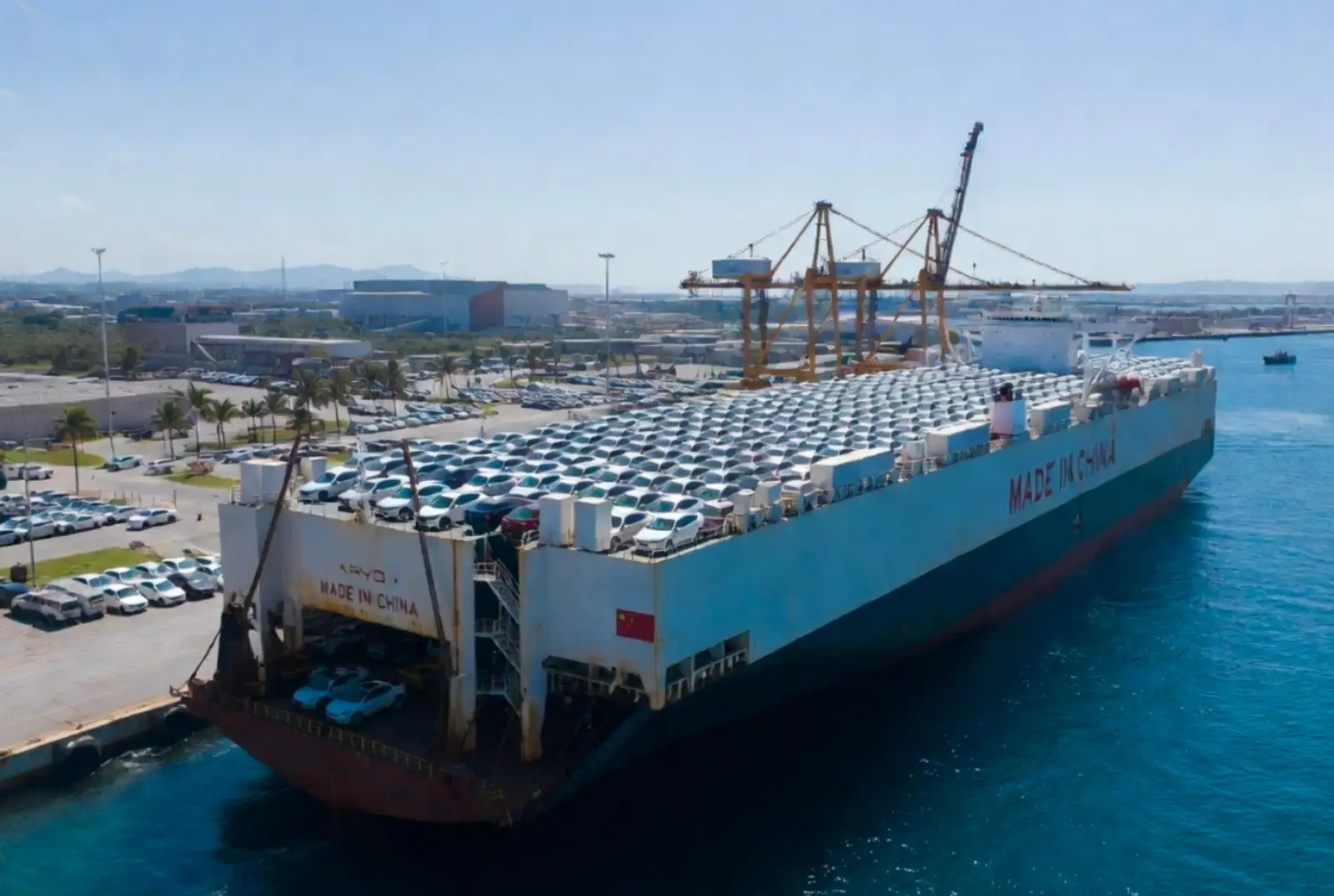
Arrival at Puerto Corinto — handles 90%+ of Nicaragua’s imports
Transit time: 30–40 days (25–35 on direct routes when available)
Dangerous Goods Classification
Electric vehicles with lithium-ion batteries are classified as dangerous goods. Your trading company must handle UN38.3 certification, proper DG container booking, and shipping on DG-approved vessels. This is not something you want to leave to an inexperienced logistics provider.
Ro-Ro vs. Container Shipping
| Ro-Ro | Container |
Cost/vehicle | Lower | Higher |
Protection | Exposed to elements | Fully enclosed |
Best for | Bulk orders, standard models | Small batches, premium models |
7. Customs Clearance & Registration in Nicaragua
Documents You Will Need
Commercial invoice (provided by your China supplier)
Bill of Lading
Certificate of Origin
Import Declaration (prepared by your customs agent)
Vehicle title or ownership document from origin
MEM prior authorization for EV tax exemption
Nicaraguan law requires all commercial imports to be processed through a registered customs agent. Choose one with experience in vehicle imports.
The Value of the Tax Exemption
Tax Type | Standard Rate | With EV Exemption |
DAI (Import Duty) | 15–30% of CIF | 0% |
ISC (Consumption Tax) | Variable | 0% |
VAT (15%) | 15% of (CIF+DAI+ISC) | 0% |
Total tax burden | 30–80%+ of vehicle value | ≈ 0% |
The exemption can save you USD 5,000–15,000 per vehicle — a decisive competitive advantage against traditional ICE imports.
Vehicle Registration
After customs clearance, register with the Dirección de Seguridad de Tránsito de la Policía Nacional. Steps include:
Presenting customs clearance documentation
Providing the vehicle’s technical specifications
Completing a vehicle inspection (VIN verification, safety features)
Paying registration and plate fees
Ensure your supplier provides a manufacturer’s certificate of conformity and technical specifications. Inconsistent model naming between Chinese export documents and Nicaraguan registration forms is a common source of delay.
8. Total Landed Cost Estimate
Cost Component | Estimate (USD) |
Vehicle FOB price (China) | 9,000–26,000 |
Ocean freight + DG surcharge | 1,500–3,000 |
Marine insurance | 200–500 |
Port handling (Corinto) | 200–400 |
Customs broker fees | 300–600 |
DAI / ISC / VAT (EXEMPTED under Law 1,111) | 0 (saves 5,000–15,000) |
GB/T adapter (optional) | 100–300 |
Total Landed Cost (per vehicle) | USD 11,300–30,800 |
Final Thoughts
For Nicaraguan importers, the Chinese EV market offers a genuine opportunity backed by real policy incentives. Law 1,111 eliminates the largest cost barrier to EV imports, and independent trading companies provide flexible access to a wide range of competitive models.
The key to a successful import is preparation: secure your MEM authorization early, understand the GB/T charging standard and plan for it, choose a trading partner with proven experience in Latin American export logistics, and verify all documentation before payment.
When these elements are in place, the combination of tax savings, competitive Chinese EV pricing, and growing demand in Central America creates a strong business case. The exemption window is finite — importers who establish their supply chain before 2027 will capture the strongest margin position.
For current pricing, model availability, and sourcing support, contact SUDI AUTO at www.sudiauto.com.
FAQ
1. Why do China-based trading companies require 100% payment before shipment?
This is the standard payment term in China’s cross-border vehicle export trade. The trading company procures vehicles from domestic suppliers using its own capital and bears logistics costs upfront. T/T 100% before shipment keeps prices competitive by eliminating financing overhead. A professional trading company will provide full documentation and real-time vehicle verification before you transfer funds.
2. Can I get CCS2 export versions instead of GB/T?
Standard vehicles sourced through independent trading channels come with GB/T ports. Factory CCS2 export versions are typically available only through official brand distributors with larger minimum orders. For most importers, a GB/T vehicle with an adapter is the most practical and cost-effective solution.
3. How do I charge a GB/T vehicle in Nicaragua?
Use a GB/T-to-CCS2 adapter for public DC fast chargers. For home or depot charging, install a dedicated GB/T wallbox, which is readily available from Chinese suppliers and also qualifies for tax exemption under Law No. 1,111.
4. Can I visit the trading company in China before ordering?
Yes. SUDI AUTO welcomes buyers to visit our warehouse in Wuxi, Jiangsu Province for vehicle inspection and face-to-face discussions. This is a recommended step for first-time importers.
5. What Chinese EV brands are available through independent trading companies?
SUDI AUTO has access to BYD, Radar pickup . We can source across brands to build the right mix for your market.
6. Is there a minimum order quantity?
No strict minimum. We work with importers ordering a single evaluation unit as well as fleet orders of 50+ vehicles. Per-unit pricing will lower with volume.
7. What is the total timeline from order to arrival in Nicaragua?
Approximately 45–60 days: 1–2 weeks for vehicle sourcing and documentation, 30–40 days for ocean freight from China to Puerto Corinto via Panama.
8. How long do the Law 1,111 tax exemptions remain in effect?
The incentives are valid for five years from February 22, 2022, expiring around February 2027. Plan your import timeline accordingly.
FAQ
Q.Who are you?
We are WUXI SUDI AUTOMOBILE NETWORK SERVICE CO., LTD., based in Wuxi City, Jiangsu Province, China, starting from 2024, as a vehicle export team of the Meidi Auto Group. In 2025, we exported over 1,000 vehicles with a trade volume of USD 23 million, serving customers across four continents. In 2026, we established vehicle warehouses in Cambodia, entering the cross-border operations development stage.
Q.How can you guarantee quality?
Always Inspection before shipment. We can conduct vehicle inspections by a third party based on the customer's requirements and issue a reliable report. Our partners include institutions such as APT and Dr. Cha.
Q.Do you have the products in stock?
Yes, our current inventory cars are displayed on the website. You can browse at any time. Large quantities must be produced according to orders, and small quantities can be consulted with our sales team.
Q.What can I buy from you?
All vehicle models of BYD brand, covering Dynasty, Ocean, Linghui, Commercial and many other series. We are the largest BYD dealer in Wuxi City, occupying 90% of Wuxi City market. We cooperate directly with BYD factory in China.
Q.Why should I buy from you not from other suppliers?
Service: Parts Express Service is provided. Online and Offline Technical Consultancy is provided. Flexible Logistic Solution provided. In-time response and on-time delivery.
Q.Can I mix different models in one container?
Yes, different models can be mixed in one container.
Q.What's your warranty term?
We offer different warranty periods for different products. Please contact us for detailed warranty terms.
Q.Will you deliver the right goods as ordered? How can I trust you?
Yes, we will. The core of our company culture is honesty and credit. We are a verified supplier by V-trust since 2024.
Q.What is your payment?
Payment Currency: USD, HKD, CNY. Payment Type: T/T.
Q.What is your shipping terms?
Delivery Terms: EXW, FCA, FOB, CFR, CIF.
Q.What services can you provide?
Customer visit or car inspection full reception service, product samples or accessory services, etc.